

Your first online sale feels exciting until someone asks for your Bureau of Internal Revenue (BIR) registration. Whether you ship from a condo, cook in your kitchen or earn through a screen, you can make the paperwork manageable.
By the end, you will know how to register correctly, pick the cheaper tax option for your numbers, keep every deadline visible, project your first year and stay motivated when progress feels slow. Set aside about 18 minutes, then use the calculators to turn the rules into a plan you can follow.
1. Why the BIR cares about your side hustle
Your business becomes a tax matter before it becomes a big business. The National Internal Revenue Code requires registration on or before business commencement. Revenue Memorandum Circular (RMC) 91-2024 reckons commencement from your first sale or 30 calendar days after the relevant registration document is issued, whichever comes first. Finish local requirements without letting them push BIR registration past that point.12

RMC 60-2020 covers businesses using electronic platforms and media. That includes your Shopee shop, Facebook orders and TikTok Shop sales. RMC 8-2024 also requires marketplace sellers to register and provide their Certificate of Registration. A small following does not remove the duty.34
Freelancers and creators belong here too. RMC 97-2021 treats monetized influencer activities as business income: advertising, sponsorships, affiliate commissions, subscriptions and digital products. A product received in exchange for promotion counts at fair market value. If you also have a job, retain your existing Taxpayer Identification Number (TIN) and update your business obligations.56
The reassuring part: income within the applicable ₱250,000 allowance can produce zero income tax. You still register and file the returns required for your tax types. The allowance works differently for employees with business income, so check the computation before assuming you owe nothing.78
A reproduced penalty schedule suggests a ₱20,000 compromise amount for city non-registration, ₱10,000 for a first invoice non-issuance offense, and ₱5,000 for failure to preserve records at ₱100,000–₱500,000 sales. Treat these as indicative figures requiring confirmation with the BIR: the original annex could not be checked directly. They illustrate why waiting can be expensive.9
Key takeaway: Register for the activity you actually run. Your income-tax allowance is a computation rule, not permission to operate unregistered.
2. Keep books from day one
Bookkeeping gives you three practical protections. First, the law requires records supporting sales, expenses, assets and liabilities. Second, an Income Tax Return (ITR) gives you income documentation to keep ready for loan, visa or apartment-lease applications. Third, your own numbers tell you whether the business earns enough to justify the time you spend.1011
A busy shop can still leave you short of cash. Record the sale, the platform's deduction, the inventory cost and the payout separately. Otherwise, a bank deposit can look like your entire revenue and a restocking payment can look like a mysterious disappearance.
Manual books are a straightforward starting point: typically a General Journal, General Ledger, Cash Receipts and Cash Disbursements books. Loose-leaf records require applicable authority plus annual binding and registration. Computerized Accounting Systems or Computerized Books of Accounts require registration and an Acknowledgment Certificate; buying software does not finish that process.101213
Preserve records for five years from the prescribed return deadline, or the actual filing date if later. Keep manual and bound loose-leaf records in hard copy and computerized records electronically. Keep relevant records longer when a dispute or refund claim remains unresolved.11

Your minimum viable bookkeeping routine
Reserve 30 minutes each week. Gather invoices and payout reports, enter sales and costs, match money received to orders, and list unpaid amounts. Save supporting documents where you can retrieve them. Finish by checking cash available for stock, household withdrawals and taxes. A recurring appointment beats a heroic catch-up session.
Use separate accounts for the things you need to understand. The suggested chart below is a working starting point, not a mandated list of account names. If you deduct itemized costs, keep evidence of both the amount and its business connection.8
| Group | Suggested accounts for your online shop |
|---|---|
| Assets | Cash/bank; platform receivables; inventory; equipment; creditable withholding tax |
| Liabilities and owner funds | Payables; tax payable; owner capital; owner drawings |
| Revenue | Product sales; creator/service revenue; returns |
| Direct costs | Cost of goods; platform/payment fees; shipping |
| Operating expenses | Advertising; software; depreciation; documented business share of home-office costs |
3. Registration, step by step, with real costs
Start a document folder before you start visiting offices. Keep identification, address documents, submitted applications and confirmations together. If you operate from a leased unit, check the applicable local requirements for that address early. Treat the sequence below as a checklist while watching the commencement deadline.
- Register your business name when applicable. The Department of Trade and Industry (DTI) charges ₱200 for barangay scope, ₱500 for city/municipality, ₱1,000 regional or ₱2,000 national, plus ₱30 documentary stamp tax. Name registration does not replace operating permits.14
- Obtain barangay clearance. Published planning estimates put this at ₱300–₱500. Ask for the actual local assessment.15
- Get the applicable Mayor's/business permit. Your Local Government Unit (LGU), through its Business Permits and Licensing Office, assesses requirements. Published estimates of ₱2,000–₱5,000 can rise with zoning, fire, sanitary and local-tax charges.1516
- Apply to the BIR. Use the individual registration application corresponding to Form 1901 through the Online Registration and Update System (ORUS), or another authorized route. Keep evidence of errors if a documented fallback is needed.26
- Check your Certificate of Registration. Form 2303 records your registered tax types. Read them before building your filing calendar.6
- Arrange compliant invoices. Under the Ease of Paying Taxes (EOPT) Act, invoices are the principal sales document for goods and services; Official Receipts (ORs) are no longer that principal document. Printed invoices require authority and an accredited printer. Display your certificate and Notice to Issue Receipt/Invoice.1117
- Register your books. ORUS generates a Quick Response (QR) registration stamp for manual/bound loose-leaf books. Choose a system you can maintain.12
- Remove the obsolete annual fee. The ₱500 BIR annual registration fee ceased on 22 January 2024. Form 0605 still exists for applicable payments without a dedicated return.1819
The estimator's invoice, book, health-permit and assistance amounts are planning allowances. Its ₱10,000 high local-permit tier is a stress-test assumption. Confirm quotes before spending, and avoid interpreting the total as a guaranteed Manila-wide price.
Electronic invoicing needs a separate check. Covered taxpayers have until 31 December 2026; e-commerce coverage excludes micro taxpayers, but separate computerized-system coverage can still matter. A Word, Excel or Google Sheets invoice alone does not qualify as an authorized electronic invoice.2021
4. 8% or graduated? Compare before you elect
The 8% option is available to eligible individuals who are not registered for Value-Added Tax (VAT) and are within ₱3 million annual gross sales/receipts. For a purely self-employed person, it applies to business gross sales/receipts plus other non-operating income above ₱250,000. It replaces both graduated income tax and the 3% percentage tax.7
Graduated taxation applies the Tax Reform for Acceleration and Inclusion (TRAIN) brackets to taxable income after allowable deductions. You can use substantiated itemized expenses or the Optional Standard Deduction (OSD), which deducts 40% of gross sales/receipts for individuals. Do not deduct inventory costs again before applying OSD.8
Under the graduated non-VAT route, add 3% percentage tax on gross sales. Under 8%, expenses do not reduce the tax base. This makes actual expense levels central to the choice: compare total taxes, not just the income-tax line.17
Elect at registration or through the applicable initial-quarter/first-quarter return. The election is irrevocable for that year and must be renewed annually. If you are also employed, the business side receives no additional ₱250,000 deduction under 8%; the salary computation uses its own applicable rules.7
The examples assume purely self-employed income, 35% allowable expenses and no credits or other income. OSD wins over itemized deductions within the graduated route here because 40% exceeds 35%. The overall winner still depends on sales.
| Annual gross sales | 8% total | Graduated + itemized + 3% | Graduated + OSD + 3% | Lowest |
|---|---|---|---|---|
| ₱500,000 | ₱20,000 | ₱26,250 | ₱22,500 | 8% |
| ₱1,200,000 | ₱76,000 | ₱134,500 | ₱122,500 | 8% |
| ₱2,500,000 | ₱180,000 | ₱383,750 | ₱352,500 | 8% |
Show the arithmetic
At ₱500,000: 8% × (₱500,000 − ₱250,000) = ₱20,000. Itemized taxable income = ₱500,000 × 65% = ₱325,000; income tax = 15% × ₱75,000 = ₱11,250; add ₱15,000 percentage tax = ₱26,250. OSD taxable income = ₱300,000; 15% × ₱50,000 + ₱15,000 = ₱22,500.
At ₱1,200,000: 8% × ₱950,000 = ₱76,000. Itemized taxable income = ₱780,000; ₱22,500 + 20% × ₱380,000 + ₱36,000 = ₱134,500. OSD taxable income = ₱720,000; ₱22,500 + 20% × ₱320,000 + ₱36,000 = ₱122,500.
At ₱2,500,000: 8% × ₱2,250,000 = ₱180,000. Itemized taxable income = ₱1,625,000; ₱102,500 + 25% × ₱825,000 + ₱75,000 = ₱383,750. OSD taxable income = ₱1,500,000; ₱102,500 + 25% × ₱700,000 + ₱75,000 = ₱352,500.87
General VAT is 12%, and exceeding ₱3 million gross sales changes the ordinary small-business position. Voluntary VAT registration also changes 8% eligibility. Near the threshold, get advice before you make pricing promises; this comparison does not model VAT.1
Key takeaway: Run your numbers before the first-quarter election. A lower headline rate does not automatically mean a lower total bill.
5. Your 2026 filing calendar
Build your calendar from Form 2303 and your actual activities. An 8% elector has a different business-tax obligation from a graduated filer; employees, rent payments and VAT status can add forms. A calendar is useful only when it matches your registration.67
The table shows statutory dates beside weekend-only adjustments for 2026. A Saturday or Sunday moves to Monday; holidays move deadlines to the next working day too, but are not calculated here. Specific BIR extensions take precedence over the ordinary dates.22
| Form or record | Statutory deadline / period | 2026 weekend-only date |
|---|---|---|
| 1701Q: quarterly income tax | First quarter: May 15; second quarter: August 15; third quarter: November 15 | May 15; August 17; November 16 |
| 1701 / 1701A / 1701-MS: annual income tax | April 15 following the income year | April 15 for 2025 income; actual extension: May 15, 2026 |
| 2551Q: percentage tax; 2550Q: VAT | January 25; April 25; July 25; October 25 | January 26; April 27; July 27; October 26 |
| 0619-E: expanded withholding remittance | 10th of following month for months 1–2 of each quarter | February 10; March 10; May 11; June 10; August 10; September 10; November 10; December 10 |
| 1601-EQ + Quarterly Alphalist of Payees (QAP) | January 31; April 30; July 31; October 31 | February 2; April 30; July 31; November 2 |
| 1601-C: compensation withholding | Monthly, if you employ staff | Check the applicable BIR schedule; filing-system rules matter |
| 1604-C + employee alphalist | January 31 following year | February 2 |
| 1604-E + payee alphalist | March 1 following year | March 2 |
| Applicable inventory list | January 30 | January 30 |
| Loose-leaf books | Normally January 15 | January 15; temporary cycle extension specified January 31 → February 2 under weekend-only rollover; confirm the applicable notice |
| Computerized books | Normally January 30 | January 30; temporary cycle extension specified February 17 |
| Manual books | Register replacement when consumed | No annual renewal deadline |
January submissions usually concern the preceding year's final quarter or records. Your 2026 annual income-tax return normally falls due on 15 April 2027. The documented 2026 exceptions include the annual-return extension to 15 May, an 18 August extension for covered monsoon/outage taxpayers, and temporary book-submission extensions. Check applicability rather than assuming every extension covers you.1023242512
Marketplace withholding is another calendar-and-records task. Revenue Regulations (RR) 16-2023 require 1% of one-half of defined gross remittances: effectively 0.5%. The ₱500,000 exception aggregates covered remittances and requires the prescribed sworn declaration. Without it, withholding applies regardless of actual receipts. Keep supported withholding certificates for credits against income tax.42627
Generally, use the Electronic BIR Forms (eBIRForms) system if you are not an Electronic Filing and Payment System (eFPS) taxpayer. Mandated/enrolled users follow eFPS requirements, including staggered dates where applicable. File, save the confirmation, then pay through an authorized ePay channel: LandBank LinkBiz, UnionBank, Development Bank of the Philippines, Maya or MyEG, including GCash through MyEG.272819

6. What a missed deadline really costs
Under EOPT and RR 6-2024, ordinary late-payment rates for micro and small taxpayers are a 10% surcharge and 6% annual interest. Everyone else faces the general 25% surcharge and 12% annual interest. Willful neglect or fraud attracts a 50% surcharge.29
Micro means gross sales below ₱3 million; small means ₱3 million to below ₱20 million. Both qualify for the ordinary reduced rates. The calculator uses a micro checkbox, so remember that qualifying small taxpayers also receive relief even though its label focuses on micro businesses.3029
Suppose you owe ₱10,000 and pay 30 days late. Micro/small surcharge is ₱10,000 × 10% = ₱1,000. Interest is ₱10,000 × 6% × 30/365 = about ₱49.32. Under general rates, those additions become ₱2,500 and ₱98.63. That is before any applicable compromise amount.2931
A compromise amount is separate from surcharge and interest. The published examples give ₱1,000 where unpaid tax is at most ₱5,000, and ₱3,000 where it exceeds ₱5,000 but is at most ₱10,000. In the example, adding ₱3,000 makes the estimated micro/small total ₱14,049.32, compared with ₱15,598.63 under general rates. Confirm the assessed amount rather than treating a calculator as a demand letter.31
Eligible micro/small invoicing compromises receive a 50% reduction; do not halve every compromise automatically. Also protect your records: the current retention rule is five years from the return deadline or later actual filing, replacing the old ten-year rule.2911
If you miss a date, gather your return, sales records and payment details promptly. Work out what is outstanding and arrange the correct filing and payment route. Avoiding the account because the numbers feel uncomfortable makes it harder to see your next useful step.
Key takeaway: A steady filing routine costs less energy than a late-payment recovery. Reduced penalties are relief, not a budgeting strategy.
7. The online economy you are stepping into
The opportunity is substantial, but measure it honestly. Google–Temasek–Bain estimates Philippine e-commerce Gross Merchandise Value (GMV) at US$24 billion in 2025, up 16%, within a US$36 billion digital economy. GMV describes transaction value; it is not company revenue or your addressable profit.32
Digital 2026 Philippines, using mainly late-2025 observations, reports 98.0 million internet users and 95.8 million social-media identities. Identities are not necessarily unique people. Advertising audiences are Facebook 95.8 million, TikTok 64.0 million adults, YouTube 59.6 million and Instagram 26.9 million; different age coverage and methods prevent a clean active-user ranking.33
Digital 2025 findings reported 3 hours 32 minutes daily on social media. The dashboard rounds that older measure to 3.5 hours. It describes attention, not a promise that viewers will buy what you list.34
Micro, Small and Medium Enterprises (MSMEs) represented 99.63% of establishments in the cited 2023 census dataset: 1,241,733 enterprises. Their 66.97% employment share refers to that establishment dataset, not all Philippine workers including informal work. You are joining a broad small-business economy, with room for a specific customer problem solved well.35

What platforms actually charge
Shopee's official terms list a 2.24% transaction fee, category-dependent commission and ₱5 order processing, waived for the first 50 successful monthly orders. A category-dependent seller-growth fee applies from 11 May 2026. Check your category before building a margin around the transaction fee alone.36
TikTok Shop lists a 2.24% transaction fee, shipping-service fees of 5% for Mall and 5.5% for Marketplace capped at ₱100 per item, and discounted ₱3 processing per order until further notice. Commission varies by subcategory and other fees may apply. Upwork's freelancer service fee is 0–15% per contract. Read the actual contract or seller dashboard before quoting.3738
8. Four ways to start online: pick one, start small
Choose a model you can test without overwhelming your household cash. The examples below are planning scenarios, not typical Philippine startup costs or measured margins. Their margin assumptions do not mean take-home pay: allow for overhead, tax, owner labour and time spent finding customers.
Reseller
Start with a focused product range you can explain and replenish. Budget for inventory, packaging, promotion, refunds and platform deductions. Watch which item earns after fees rather than collecting stock because it looks good on camera.
Illustrative scenario, ManilaOpenHouse assumptions, not survey data: ₱15,000 startup; first sale within 2 weeks; 20–30% gross margin after platform fees. This scenario uses margin after fees, so do not subtract those same fees twice.

Home-based food
Choose a short menu, record ingredient quantities and limit your first batch to what you can fulfil consistently. Packaging, utilities and spoilage belong in the calculation. Obtain applicable local operating, sanitary and health permits; a home kitchen does not remove the permit check.1516
Illustrative scenario, ManilaOpenHouse assumptions, not survey data: ₱10,000 startup; first sale in days; 40–50% gross margin; applicable permits needed. Confirm what your local authority requires before accepting orders.
Freelancer
Sell a clear outcome rather than a vague willingness to help. Include equipment, connectivity, software and client acquisition in your budget. Test the 8% option early, while counting unpaid prospecting and revisions before deciding how profitable a project feels.
Illustrative scenario, ManilaOpenHouse assumptions, not survey data: ₱5,000–₱40,000 startup depending on laptop needs; first client in 1–2 months; 70–85% margin. In this low-expense scenario, the 8% option usually wins; compare your own figures and employment status.
Creator
Build a repeatable production routine and enough runway to keep making useful work before monetization. YouTube advertising eligibility requires 1,000 subscribers plus either 4,000 valid public watch-hours in the preceding 12 months or 10 million valid public Shorts views in 90 days. A policy review follows; reaching the numbers does not guarantee acceptance.39
Illustrative scenario, ManilaOpenHouse assumptions, not survey data: ₱8,000–₱50,000 startup and 6–12 months to monetize. The widget uses 6 months as an illustrative first-paid-sale horizon, not a platform guarantee; creator margin is left unspecified.
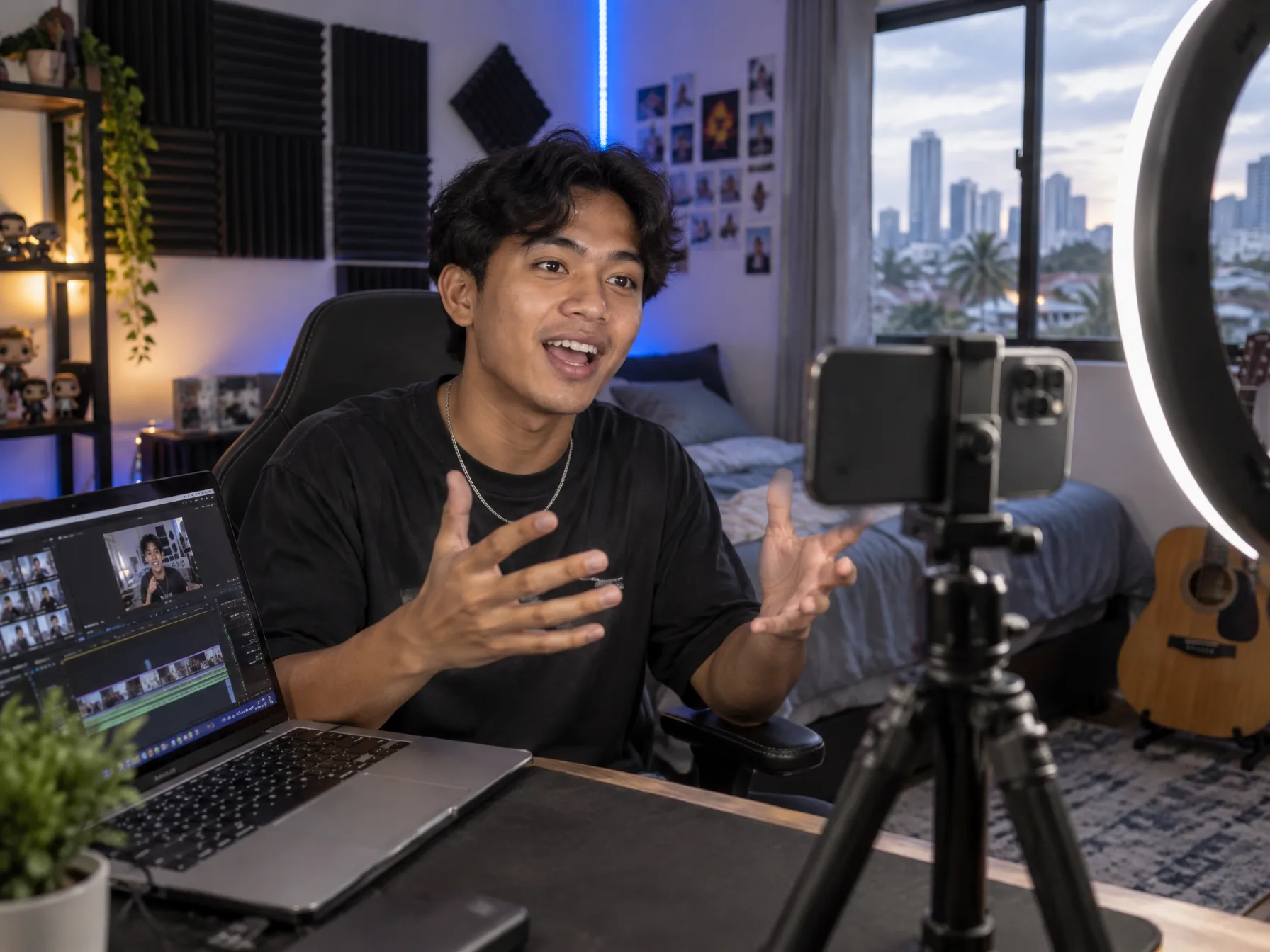
9. Project your first year
Start with month-one sales you can explain: orders times selling price, or clients times project value. Monthly growth is an assumption, not a target you must hit. Gross margin is what remains after direct costs; fixed costs continue even when sales are quiet. Enter platform/payment fees separately unless your margin already includes them.
The playground grows sales month by month, subtracts costs and allocates estimated annual tax in proportion to sales. It helps you see whether growth produces cash or merely more work. Its month labels use the next calendar year; treat the result as a planning model rather than a prediction.
Set aside your tax every month in a separate GCash or bank pocket. Give that balance a clear purpose before household spending absorbs it. Revisit the estimate when sales or costs change, and reconcile actual payments and supported withholding credits when preparing returns.
Try a slower-growth version alongside your hopeful one. Ask whether you could still pay fixed costs and buy the next batch. If cumulative cash remains negative, change the price, product mix or cost structure before assuming more orders will solve everything.
10. Price yourself to earn while you pursue it
Underpricing often begins with an understandable wish: you want someone to say yes. But a price that covers materials while ignoring preparation, revisions, fees and tax can turn a full calendar into an exhausting cash shortage. Make your own pay visible in the quote.
Use a “take-home first” method. Choose the monthly amount you need to receive personally, add business costs and estimated tax, then divide the required annual revenue by realistic billable hours. Billable hours exclude prospecting, administration and unpaid learning. Working weeks should leave room for breaks and interruptions.
The calculator solves for revenue needed to meet your target, then shows hourly, eight-hour daily and twenty-hour project equivalents. These are planning anchors. A fixed project still needs a written scope, revision limit and allowance for its actual demands.
If the resulting rate feels difficult to sell, explore a narrower service, a clearer deliverable or better-fit clients. Test demand with a small offer. A cheaper rate should be a deliberate experiment with a limit, not a permanent promise made before you understood your costs.
11. Ikigai, kaizen, muga-muchū: a Japanese mindset for your business
Ikigai is what makes life feel worthwhile, including ordinary pleasures and relationships; paid work is optional. The familiar four-circle diagram is a Western adaptation popularized by Marc Winn in 2014, not an ancient Japanese formula. Use it as a reflection tool without asking your business to supply every source of meaning.40
Ken Mogi's explanatory framework has five pillars: starting small, releasing yourself, harmony and sustainability, joy in little things, and being in the here and now. In practice, choose one worthwhile task today and a pace that fits your life. A completed reconciliation can count as progress even when a video gets few views.41
Small improvements, useful restraint
Kaizen means improvement; in management, continuing improvement involving everyone. Improve one listing a day: clarify its measurements, replace a confusing description or answer a recurring question. You can make the shop easier to buy from without redesigning everything at once.42
Mottainai expresses regret at wasting something's value or potential, beyond recycling. Apply it to inventory: check what you already hold before buying more, and plan around stock that needs attention. Gaman means enduring hardship with patience and dignity. Use it for your first 90 days by keeping the routine while honestly reviewing what customers tell you.4344
Shoshin is beginner's mind: openness, curiosity and willingness to question assumptions. Read your own reviews as if you had never seen the product. Ask what confused the buyer before defending the explanation you intended to give.45
Attention and capacity
Muga-muchū means total absorption or engrossment, forgetting oneself. A comparison with psychological flow is an analogy. Give yourself a deep-work block for editing, designing or reconciling, with messages checked afterward. Protecting attention can be a concrete habit even when inspiration is absent.4647
Kodawari is uncompromising dedication to craft and personal standards. Choose your product's one obsessive detail: a consistent portion, accurate sizing or an unusually clear handover document. Make it useful to the customer and repeatable for you.48
Hara hachi bu is an Okinawan eating reminder to stop around 80% fullness. Borrow it explicitly as a business metaphor: do not scale past 80% of what you can fulfil comfortably. That capacity rule is our analogy, giving you room for a delayed delivery or a household interruption.49

Key takeaway: Build motivation into small actions: improve one listing, protect one work block and leave space in your fulfilment capacity.
12. Words from people who built things
Read these as prompts for action, not promises that persistence guarantees success. Pick one that helps with today's task: trying a reversible offer, asking a better question, doing the small job yourself or protecting time for something meaningful.
Start this week: a 7-day plan
You do not need to solve the whole year tonight. Give each day a finish line you can recognize, and move registration earlier if your commencement date requires it. These seven actions turn a worrying topic into a working system.
- Day 1: Write down your business activity, address and commencement timing; gather registration documents.
- Day 2: Check business-name and local-permit requirements, and request actual quotations.
- Day 3: Start or complete the applicable BIR registration route; check your registered tax types.
- Day 4: Arrange compliant invoices and registered books; create your document folders.
- Day 5: Compare tax options with your own sales and costs; note your election deadline.
- Day 6: Add applicable filing dates and preparation reminders; create a separate tax pocket.
- Day 7: Test your first-year projection and price; book next week's 30-minute bookkeeping session.
When you finish, keep the plan where you pack orders or open your laptop. Next week, check what actually happened and adjust one assumption. Consistent, visible progress is a better companion than waiting to feel completely ready.
Running your business from a home or leased unit? Browse ManilaOpenHouse listings as you plan a space that fits your work and daily life. For questions, email manilaopenhouse@gmail.com.
Sources
- https://lawphil.net/statutes/repacts/ra2024/ra_11976_2024.html
- https://bir-cdn.bir.gov.ph/BIR/pdf/RMC%20No.%2091-2024%20Digest.pdf
- https://bir-cdn.bir.gov.ph/local/pdf/RMC%20No.%2060-2020.pdf
- https://bir-cdn.bir.gov.ph/BIR/pdf/RMC%20No.%208-2024.pdf
- https://bir-cdn.bir.gov.ph/local/pdf/RMC%20No.%2097-2021.pdf
- https://www.bir.gov.ph/BIRCC-RDO-External-Service-08
- https://elibrary.judiciary.gov.ph/thebookshelf/showdocs/2/90318
- https://bir-cdn.bir.gov.ph/local/pdf/RR%20No.%208-2018.pdf
- https://www.scribd.com/document/345366215/RMO-No-7-2015-Annex-A-pdf
- https://bir-cdn.bir.gov.ph/local/pdf/RMC%20No.%20131-2020%20Professionals.pdf
- https://bir-cdn.bir.gov.ph/BIR/pdf/RR%20No.%207-%202024.pdf
- https://bir-cdn.bir.gov.ph/local/pdf/RMC%20No.%203-2023.pdf
- https://bir-cdn.bir.gov.ph/local/pdf/RMC%20No.%205-2021.pdf
- https://bnrsprodtestsite.dti.gov.ph/faq
- https://www.taxumo.com/blog/how-to-register-a-business-in-the-philippines-2025-step-by-step-guide/
- https://www.respicio.ph/commentaries/business-registration-in-makati-costs-and-requirements
- https://bir-cdn.bir.gov.ph/local/pdf/RMC%20No.%2075-2023.pdf
- https://d3rv4lo6ebphhq.cloudfront.net/Publications/Publication_File_1720748060.pdf
- https://www.bir.gov.ph/bir-forms?datasetCode=3381&idTag=BIR1602Q&label=1602Q&tab=Payment%2FRemittance+Forms&type=TAB+LINK
- https://bir-cdn.bir.gov.ph/BIR/pdf/RR%20No.%2026-2025.pdf
- https://www.grantthornton.com.ph/technical-alerts/tax-alert/2026/bir-issues-guidelines-on-electronic-invoicing-retains-31-dec-2026-deadline/
- https://taxcalculator.com.ph/guides/philippine-tax-calendar-2026
- https://cloudcfo.ph/blog/bir-tax-filing-extension-august-2026
- https://bir-cdn.bir.gov.ph/BIR/pdf/RMC%20No.%2030-2026.pdf
- https://cloudcfo.ph/blog/bir-books-of-accounts-deadline-extension
- https://help.gcash.com/hc/en-us/articles/31622004752153-Advisory-on-Revenue-Regulation-16-2023
- https://www.bdblaw.com.ph/images/advisory/190_Advisory_RMC_No20-2026.pdf
- https://bir-cdn.bir.gov.ph/BIR/pdf/RMC%20No.%2087-2024.pdf
- https://bir-cdn.bir.gov.ph/BIR/pdf/RR%206-2024%20%28final%29.pdf
- https://bir-cdn.bir.gov.ph/BIR/pdf/RR%208-2024.pdf
- https://www.forvismazars.com/ph/en/insights/tax-alerts/penalties-for-tax-return-late-filing
- https://services.google.com/fh/files/misc/philippines_e_conomy_sea_2025_report.pdf
- https://datareportal.com/reports/digital-2026-philippines
- https://aws2.campaignasia.com/article/filipinos-spend-more-time-than-global-average-on-social-media/500622
- https://pia.gov.ph/news/dti-msme-council-eye-franchising-to-grow-local-businesses/
- https://help.shopee.ph/portal/4/article/77272
- https://seller-ph.tiktok.com/university/essay?knowledge_id=2675772847064834&lang=en
- https://support.upwork.com/hc/en-us/articles/211062538-Learn-about-the-Freelancer-Service-Fee
- https://support.google.com/youtube/answer/72851?hl=en
- https://theviewinside.me/ikigai
- https://www.hachette.com.au/ken-mogi/the-little-book-of-ikigai-the-secret-japanese-way-to-live-a-happy-and-long-life
- https://kaizen.com/what-is-kaizen/
- https://www.env.go.jp/recycle/3r/en/approach/02.pdf
- https://americanart.si.edu/exhibitions/gaman
- https://www.sfzc.org/offerings/entering-practice
- https://dictionary.goo.ne.jp/thsrs/3532/meaning/m0u/
- https://www.tkgje.jp/entries/05500/05661_mugamuchuu.html
- https://www.japantimes.co.jp/tag/third-wave-coffee/
- https://www.bluezones.com/live-longer-better/
- https://news.stanford.edu/stories/2005/06/steve-jobs-2005-graduates-stay-hungry-stay-foolish
- https://www.aboutamazon.com/news/company-news/2016-letter-to-shareholders
- https://www.cbsnews.com/news/us-china-russia-elon-musk-entrepreneurs-insane-vision-becomes-reality/
- https://www.gsb.stanford.edu/insights/jensen-huang-how-use-first-principles-thinking-drive-decisions
- https://www.gsb.stanford.edu/insights/sara-blakely-start-small-think-big-scale-fast
- https://www.econclubny.org/documents/10184/109144/2015MaTranscript.pdf
- https://www.philstar.com/business/2017/08/20/1731012/xurpas-transform-platform-company
Research date: 4 October 2026. Tax rules change; confirm with the BIR or a CPA before acting. Calculators are estimates for a non-VAT individual taxpayer and are not tax advice. Photos are AI-generated illustrations.
Photos







Related articles

E-Invoicing in the Philippines 2026: What the New BIR Rules Require, Who Must Comply, and the Penalties for Getting It Wrong
By 31 December 2026, many Philippine businesses that sell online, or that run their books on accounting or invoicing software, must stop handing out paper or…

One Person Corporation to Exit: What Investors Want in the Philippines
You can own every share of your company and still build something another investor will want to buy. The harder question is whether the company can keep…

Floor Plan to 3D: AI Video for Philippine Property Listings
If you are selling a Manila home, you can now turn its floor plan into a furnished 3D walkthrough before a buyer visits. Across 2025–2026, editable plan…