

A registered export manufacturer earning ₱300M gross and ₱150M net a year would pay about ₱600M in income tax over 16 years at the regular 25%. With CREATE MORE (RA 12066), a six-year tax holiday and the 5% special tax cut that to ₱150M: ₱450M saved, 75%, worth ₱268.5M in today's pesos. Here are the steps, ten scenarios that change the answer, and what we could not verify.
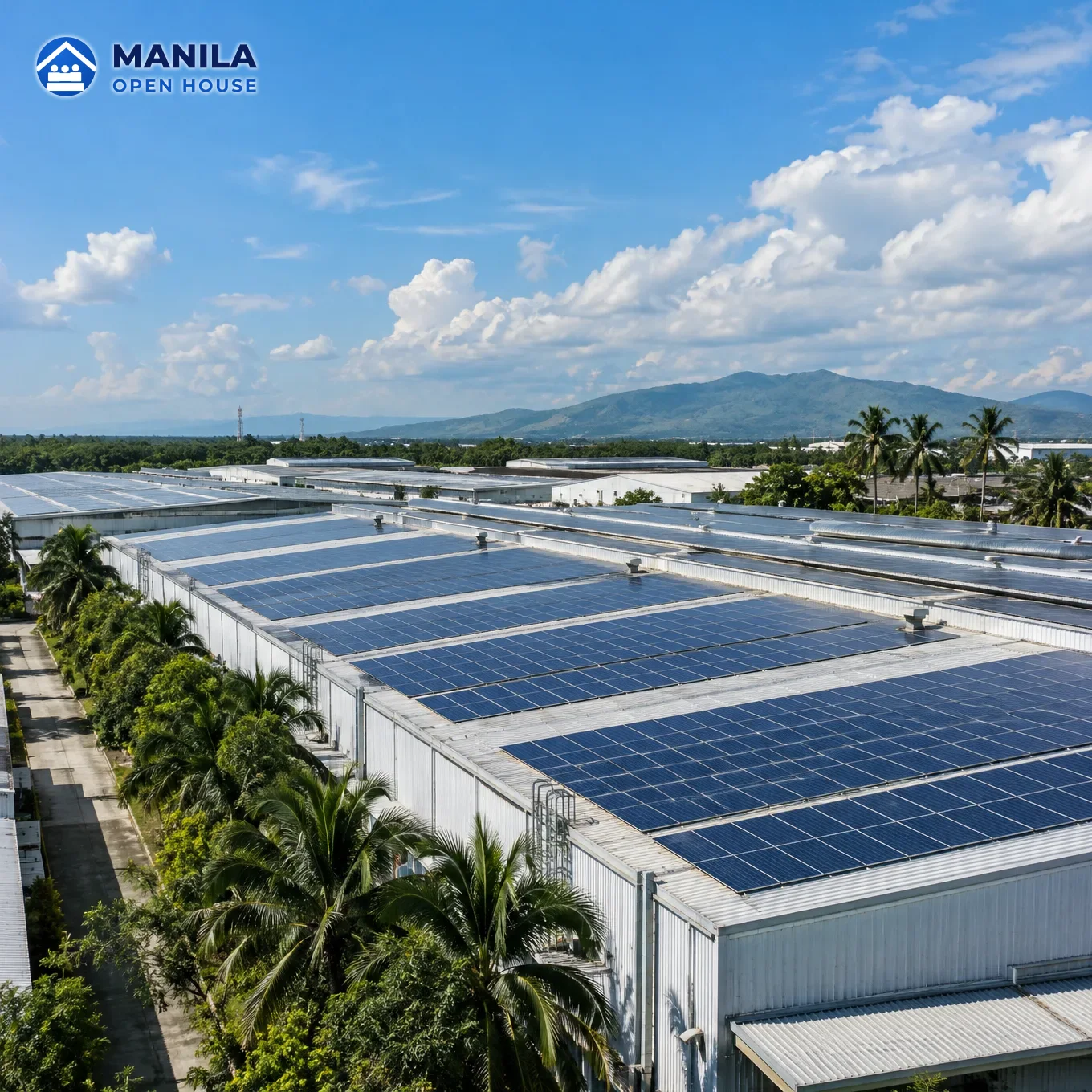
Data as of 20 Oct 2026 General information, not tax, legal or investment advice. Numbers are our illustrative model, not a quote. Photos are AI-generated illustrations, not photos of real projects.
Read this first.
- Illustrative, not advice. Every peso figure comes from a simplified model of RA 12066 that we run on our own calculator. It is not a quote, a ruling or a promise of any incentive. Confirm your case with the investment promotion agency (IPA) and a Philippine tax adviser.
- Independent. Manila Open House Homes is an independent publisher. We are not affiliated with PEZA, BOI, the FIRB, the BIR, the Department of Finance or any other agency, and nothing here is an offer or solicitation to sell, lease or invest.
- Property inquiries. If you ask about a specific listing or estate through a link on this page, your request goes to the developer or a PRC-licensed practitioner. Verify any practitioner's PRC licence. We take no commission on this page. See the listing disclaimer.
- Privacy. The tools below run in your browser. Nothing you type is sent to us, stored or tracked. A share link puts your numbers in the web address, so share it only with people you trust. See the Privacy Notice.
- Labels. Verified means it is in the statute or a primary-style source. Unverified means sources conflict or we could not confirm it. Our analysis means it is our arithmetic or judgement. Corrections: manilaopenhouse@gmail.com.
The scenario: one exporter, one set of assumptions
These are the defaults behind the ₱450M headline. They are also the defaults in the calculator link at the end. Change any of them and the answer moves.
| Assumption | Value |
|---|---|
| Gross income earned a year | ₱300,000,000 (US$5.17M) |
| Net taxable income a year | ₱150,000,000 (a 50% margin) |
| Capital invested | ₱5,000,000,000, so an investment promotion agency (IPA) approves it Verified |
| SIPP tier | Tier I |
| Location | All other areas (outside NCR and the metro or contiguous list) Unverified |
| Enterprise | Registered export enterprise (at least 70% of output exported) Verified[1, 3] |
| After the holiday | 5% special corporate income tax (SCIT) on gross income |
| Regular rate for comparison | 25% of net taxable income Verified[5] |
| Horizon, start, discount rate | 16 years, from 2027, 8% |
| Exchange rate | ₱58 to US$1 (assumption, not a quote) |

How the law gets to ₱450M
Three rules do the work. First, the income tax holiday (ITH) comes from a three-by-three table of SIPP tier and location. Tier I in "all other areas" gets 6 years Verified[1]. Second, after the holiday an export enterprise can pick the 5% special tax on gross income for 10 more years Verified[1, 3]. Third, an unregistered firm pays 25% of net income every year.
- Years 1 to 6, holiday. Tax is zero. The regular tax would be ₱37.5M a year, so six years save ₱225M.
- Years 7 to 16, special tax. 5% of ₱300M is ₱15M a year against ₱37.5M, saving ₱22.5M a year or ₱225M over ten years.
- Total. ₱225M + ₱225M = ₱450M (US$7.76M), or 75% of the ₱600M you would otherwise pay. Discounted at 8%, that is ₱268.5M in today's pesos. Our analysis
Effective tax over the period is 6.25% of net income, against 25%. Hover or tap a year below to see it.

Years 1 to 6 (2027 to 2032): income tax holiday, tax ₱0. Years 7 to 16 (2033 to 2042): 5% of gross, ₱15M a year against ₱37.5M regular tax.
Run your own numbers
The calculator starts on the worked example. It follows the same rules as our full CREATE MORE calculator: change tier, location, export or domestic, regime, rates, horizon and the eight deductions. The investment box flags IPA or FIRB approval for you, and picking a domestic enterprise switches off SCIT.
Use Copy share link to save your case in the web address. Links built with the same keys as the main calculator also prefill it, so the deep link at the end of this article opens here showing ₱450M, 75% and NPV ₱268.5M.

| Years | Phase | Regular tax a year | With incentives a year | Saved |
|---|---|---|---|---|
| 1 to 6 (2027 to 2032) | Income tax holiday | ₱37.5M | ₱0 | ₱225M |
| 7 to 16 (2033 to 2042) | 5% special tax | ₱37.5M | ₱15M | ₱225M |
| Total | ₱600M | ₱150M | ₱450M (75%), NPV ₱268.5M |
Best pick for each scenario
Short answers first, then the reasoning. All figures use the same ₱300M gross and ₱150M net unless a card says otherwise.
| Scenario | Holiday | Tax paid | Saved | Saved % | NPV (8%) | Status |
|---|---|---|---|---|---|---|
| Exporter, Tier I, other areas, SCIT | 6 yrs | ₱150M | ₱450M | 75% | ₱268.5M | Verified Our analysis |
| Same, NCR | 4 yrs | ₱225M | ₱375M | 62.5% | ₱235.18M | Our analysis |
| Same, metro or contiguous | 5 yrs | ₱187.5M | ₱412.5M | 68.75% | ₱252.48M | Unverified Our analysis |
| Tier II or III, other areas | 7 yrs | ₱135M | ₱465M | 77.5% | ₱277.25M | Unverified Our analysis |
| Investment ₱20B (FIRB), 26-year window (regular tax ₱975M) | 6 yrs | ₱300M | ₱675M | 69.23% | ₱312.57M | Verified Our analysis |
| Domestic market, EDR, no extra deductions | 6 yrs | ₱300M | ₱300M | 50% | ₱205.07M | Verified Our analysis |
| Domestic market, EDR, deck deductions | 6 yrs | ₱164M | ₱436M | 72.67% | ₱264.8M | Unverified Our analysis |
| Low margin (net ₱15M), SCIT | 6 yrs | ₱150M | -₱90M | -150% | -₱30.23M | Our analysis |
| Low margin (net ₱15M), EDR | 6 yrs | ₱30M | ₱30M | 50% | ₱20.51M | Our analysis |
| Relocated out of NCR, 8-year cap applied | 8 yrs | ₱120M | ₱480M | 80% | ₱285.36M | Unverified Our analysis |
| Relocated out of NCR, no cap | 9 yrs | ₱105M | ₱495M | 82.5% | ₱292.86M | Unverified Our analysis |
| Income growing 5% a year | 6 yrs | ₱252.83M | ₱634.32M | 71.5% | ₱349.89M | Our analysis |
Where you build
1. Exporter in "all other areas" (base case)
Best pick: register, take the 6-year holiday, then the 5% SCIT, as long as your margin is above 20% and your enhanced deductions would stay under about ₱75M a year. Saved ₱450M (75%), NPV ₱268.5M. Our analysis
2. The same project in NCR
Best pick: only if you must be in Metro Manila. The holiday is 4 years, so you save ₱375M (62.5%), NPV ₱235.18M. That is ₱75M less than "all other areas". Our analysis The ITH table itself is Verified[1].
3. Metro or contiguous area
Best pick: a solid middle. 5-year holiday, saved ₱412.5M (68.75%), NPV ₱252.48M. Which towns count comes from a TIEZA FAQ, not the IRR text, so ask your IPA to confirm your LGU in writing. Unverified[13]

Location is the biggest lever you control. Tap a cell below to compare.
| Tier | NCR | Metro or contiguous | All other areas |
|---|---|---|---|
| Tier I | ₱375M 4 yr holiday | ₱412.5M 5 yr holiday | ₱450M 6 yr holiday |
| Tier II | ₱412.5M 5 yr holiday | ₱450M 6 yr holiday | ₱465M 7 yr holiday |
| Tier III | ₱450M 6 yr holiday | ₱465M 7 yr holiday | ₱465M 7 yr holiday |
What you build and how big
4. Tier II or Tier III activity
Best pick: do not chase a tier. Tier II and III get 7 years in "all other areas", saving ₱465M (77.5%), NPV ₱277.25M: ₱15M more than Tier I. Your tier comes from the activity code in the current SIPP, and two summaries of the 2026 plan disagree. Unverified[16, 17]
5. Investment above ₱15 billion (FIRB)
Best pick: model the full window. Above ₱15B the FIRB approves and the post-holiday period is 20 years Verified[1]. Inside a 16-year view the saving is unchanged at ₱450M. Over the full 26-year window it is ₱675M (69.23%) of ₱975M regular tax. Our analysis


Who you sell to, and how profitable you are
6. Domestic market enterprise (EDR only)
Best pick: EDR, and build the deduction file. SCIT is for export enterprises only. A domestic firm gets the holiday and then EDR at 20% of taxable income. With no extra deductions it saves ₱300M (50%), NPV ₱205.07M. With deck-style deductions of about ₱100M a year it saves ₱436M. Verified[1, 3] The post-holiday length is 10 years in the statute, 5 in one secondary source. Unverified[15]
7a. Low-margin firm
Best pick: EDR, not SCIT. SCIT is 5% of gross, which equals 25% of net at a 20% margin. Below that it costs more than the regular tax. At ₱15M net on ₱300M gross, SCIT leaves you ₱90M worse than no registration, while EDR still saves ₱30M. Our analysis
7b. High-deduction firm
Best pick: EDR once deductions pass about ₱75M a year. Past that, 20% of what is left beats 5% of gross. With the 2034 cliff on a deck-style mix, the crossover moves to about ₱110.29M. Our analysis The deck example (₱100M a year) ends at ₱164M of tax, saving ₱436M.

What the parent keeps
8. Foreign parent taking dividends
Best pick: get tax advice before you count the saving as parent-level cash. The ₱450M is corporate income tax at the Philippine entity. Withholding on dividends or branch profits sits on top, and sources conflict: 25% final tax reducible to 15%, or exempt for registered activities. We could not resolve it. Unverified[10]
Moving, or choosing an estate
9. Relocating out of NCR (bonus years)
Best pick: plan on 8 holiday years, not 9. The statute adds 3 years for full relocation out of NCR and 2 for conflict or disaster areas Verified[1]. An 8-year cap on the holiday rests on one secondary source Unverified[15]. Tier I in "all other areas" becomes 8 years with the cap: saved ₱480M (80%). Without a cap it would be 9 years: ₱495M. Relocating into a metro area gives 8 years either way.
10. Locating in an economic estate
Best pick: shortlist estates where your IPA confirms the bracket. On our reading, estates in Lipa and Malvar (Batangas), Balamban (Cebu) and Tarlac City fall in "all other areas" (₱450M), while Lapu-Lapu on Mactan is part of Metro Cebu (₱412.5M). That reading is unverified. Unverified Read our independent guide to Aboitiz Economic Estates industrial lots and browse a listing on our MLS.



One more case: a firm whose income grows 5% a year saves ₱634.32M (71.5%), NPV ₱349.89M, because later, larger tax bills fall inside the cheaper special-tax years. Our analysis
Special tax or enhanced deductions? Find your break-even
An export enterprise picks one regime for the post-holiday years, and the choice is irrevocable Verified[3]. SCIT is 5% of gross income and replaces national and local taxes. EDR keeps a 20% rate on taxable income after enhanced deductions, with a local tax of up to 2% of gross still possible Verified[1, 6].
| After the holiday | Tax paid | Saved | Saved % | NPV | Status |
|---|---|---|---|---|---|
| 5% special tax on gross (SCIT) | ₱150M | ₱450M | 75% | ₱268.5M | Verified Our analysis |
| EDR, deck deductions | ₱164M | ₱436M | 72.67% | ₱264.8M | Unverified Our analysis |
| EDR, no deductions claimed | ₱300M | ₱300M | 50% | ₱205.07M | Verified Our analysis |
The rule of thumb. With ₱150M net and ₱300M gross, SCIT costs ₱15M a year. EDR costs 20% × (₱150M − deductions). They are equal at ₱75M of effective deductions. Below that, SCIT is cheaper; above it, EDR wins. Our analysis
The 2034 cliff. The reinvestment allowance ends for availments after 31 December 2034 Verified[1, 6]. In the deck mix it is 40% of deductions, so EDR tax jumps from ₱10M to ₱18M a year in 2035. Drag the slider and flip the toggle to see it.

| Deductions a year | EDR, no sunset | EDR, 2034 sunset |
|---|---|---|
| ₱0 | ₱300M | ₱300M |
| ₱25M | ₱250M | ₱266M |
| ₱50M | ₱200M | ₱232M |
| ₱75M | ₱150M | ₱198M |
| ₱100M | ₱100M | ₱164M |
| ₱125M | ₱50M | ₱130M |
| ₱150M | ₱0 | ₱96M |
Step by step: from SIPP check to annual compliance
- Check the SIPP listing. Your activity must be listed in the current Strategic Investment Priority Plan. Unlisted projects are automatically disapproved, and the plan is valid for three years Verified[1]. The 2026 plan is MO 47; the two summaries we found differ, so read the order itself and note your tier. Unverified[16, 17]
- Choose the approving agency. PEZA, BOI, TIEZA or another IPA approves capital up to and including ₱15B; the FIRB approves anything above Verified[1]. Pick the agency whose scope fits your activity and site.
- Register. The IPA decides within 20 working days, with one extension of up to 20 more Verified[1]. The IPA also issues the zero-rating certification, subject to BIR post-audit Verified[11, 12]. One secondary summary says commercial operations must start within three years of registration. Unverified[4]
- Start the holiday clock. Ask the IPA in writing when your ITH begins. Our model assumes year 1 is 2027; the real start date depends on your registration and operations, and we did not verify the rule. Unverified
- Operate and prove the export test. At least 70% of annual output must be exported. Missing it can cost you zero-rating the next year. Verified[3] Keep separate books for the registered project.
- Choose SCIT or EDR before the holiday ends. Use the break-even tool with your real margin and deductions. The choice is irrevocable. Verified[3]
- Claim VAT and duty relief. Registered export enterprises buy locally at 0% VAT and import project goods free of import VAT and duty. VAT refunds must be decided within 90 days of complete documents. Verified[1, 3, 12]
- File the annual compliance pack. On EDR you must substantiate deductions and file a Notarized Comprehensive Summary Report with the IPA within 30 days after the income tax return, starting with taxable years ending 31 December 2026 Verified. That is DOF Order 026-2026, circularized by FIRB Advisory 010-2026 and BIR RMC 105-2026 (posted 29 September 2026). Related-party deductions are disallowed unless at arm's length. [6, 8]
Tips and tricks
- Test both regimes with your real margin. The 20% margin line is the fastest screen. Our analysis
- Power is the cleanest deduction. Power expense earns a 100% additional deduction, so 200% in total, confirmed in the statute and DOF Order 026-2026. Verified[1, 6] The deduction is on actual electricity cost for registered operations, so ask your IPA how self-generated or rooftop power is treated. We did not verify that. Unverified
- Treat the other deduction rates as provisional. Additional depreciation (10% buildings, 20% machinery), R&D, training, labor and domestic inputs rest on secondary sources. Unverified[6, 9]
- Look at NPV, not just the total. Early years are worth more in today's pesos: ₱450M nominal is ₱268.5M at 8%.
- Diarise 2034. Plan reinvestment before 31 December 2034 if you rely on that allowance.
- Keep related-party deals at arm's length. Disallowed deductions raise EDR tax.
- Share the link, not a spreadsheet. The calculator's share link carries every input.
Common mistakes
- Assuming SCIT is for everyone. It is for export enterprises. Domestic firms get EDR.
- Choosing SCIT on a thin margin. Below a 20% net margin it can cost more than no incentive.
- Forgetting the registered-activity test. Not listed in the SIPP means automatically disapproved.
- Counting on the bonus years. The +3 for relocation is in the statute; the cap on total holiday years is unverified.
- Trusting a town list. Check your LGU against the IRR or ask your IPA.
- Ignoring the 2034 sunset. EDR cost rises when the reinvestment allowance ends.
- Skipping the summary report. On EDR, missing the notarized report can disallow deductions.
- Treating the saving as parent cash. Dividend withholding is a separate layer.
Pros and cons
| Pros | Cons |
|---|---|
| Zero income tax for 4 to 7 years Verified | Only registered activities in the SIPP qualify Verified |
| 5% of gross is simple and predictable for exporters Verified | SCIT can cost more than regular tax at low margins Our analysis |
| 0% VAT on local purchases and duty-free project imports for exporters Verified | The 70% export test applies every year Verified |
| Longer holidays outside NCR and for Tier II and III Verified | Metro list, bonus cap and several deduction rates are unconfirmed Unverified |
| EDR rewards power, labor, training and R&D spend Verified | EDR needs substantiation and a notarized summary report Verified |
| Incentives run 14 to 27 years by bracket Verified | Regime choice is irrevocable; incentives can be cancelled for material violations Verified[1] |
Run it with your numbers. This link opens the main calculator with the exact worked-example assumptions filled in.
Open the calculator with this scenario Read the full CREATE MORE guide Aboitiz estates guide
Checklists
Use the readiness checklist before you spend on advisers. The static version is below it for printing.
Before you apply
- My activity code is in the current SIPP and I know its tier.
- I know whether at least 70% of annual output will be exported.
- My capital figure is settled: up to ₱15B goes to an investment promotion agency, above it to the FIRB.
- I confirmed the location bracket with the agency (the metro list is unverified).
Structure and cash
- I took legal advice on the land route for the site.
- My tax adviser reviewed dividend and branch-profit withholding for the parent.
- I modelled SCIT against EDR with my own margin and deductions, including the 2034 cliff.
After approval
- I keep separate books for the registered project.
- I recorded the regime choice and know it is irrevocable.
- I keep evidence of the 70% export share every year.
- EDR users: I diarised the Notarized Comprehensive Summary Report, due within 30 days after the income tax return.
- I set reminders for the end of the holiday and for 31 December 2034.
12 FAQ
How does an exporter save ₱450 million?
A registered export manufacturer in Tier I, in "all other areas", pays no income tax for six years, then 5% of gross income for ten. On ₱300M gross and ₱150M net a year, that is ₱150M of tax over 16 years against ₱600M at the regular 25%. The difference is ₱450M, or 75%, and ₱268.5M in today's pesos at 8%. This is our model of the law, not a promise. Our analysis
Is SCIT available to domestic enterprises?
No. The 5% special corporate income tax is for export enterprises, meaning at least 70% of annual output is exported. Domestic market enterprises receive the income tax holiday and then the enhanced deduction regime at 20% of taxable income after enhanced deductions. Verified[1, 3]
What is the difference between the holiday, SCIT and EDR?
The holiday means no income tax for 4 to 7 years. SCIT is 5% of gross income and replaces national and local taxes. EDR is 20% of taxable income after enhanced deductions, with a local tax of up to 2% of gross income still possible. You choose one after the holiday and cannot switch. Verified[1, 6]
Who approves the registration, and how fast?
An investment promotion agency such as PEZA or BOI approves projects with capital up to and including ₱15 billion, within 20 working days with one extension of up to 20. The FIRB approves projects above ₱15 billion. The activity must be in the SIPP or it is automatically disapproved. Verified[1]
How long do the incentives last?
For IPA-approved projects, 4 to 7 years of holiday plus 10 years, so 14 to 17 years. For FIRB projects, the same holiday plus 20 years, so 24 to 27. Holiday length depends on tier and location. Bonus years apply for relocating out of NCR (+3) and for conflict or disaster areas (+2). Verified[1]
How much does location matter?
In the worked example, NCR saves ₱375M, a metro or contiguous area ₱412.5M and "all other areas" ₱450M. That is ₱75M between NCR and the rest. Which towns count as metro or contiguous comes from a TIEZA FAQ and has not been checked against the IRR. Unverified[13]
When should I choose EDR over SCIT?
SCIT equals the regular tax at a 20% net margin, so thin-margin firms usually do better on EDR. At ₱150M net and ₱300M gross, EDR wins once effective deductions pass about ₱75M a year, or about ₱110.29M when the 2034 reinvestment sunset is included. Test your own numbers in the break-even tool. Our analysis
What happens in 2034?
The reinvestment allowance (up to 50% of the amount reinvested within five years) ends for availments after 31 December 2034. In the deck example, that lifts EDR tax from ₱10M to ₱18M a year from 2035, so total tax is ₱164M instead of ₱100M. Verified[1, 6]
Do dividends to a foreign parent face withholding?
Probably, but we could not pin the rate. Secondary sources describe 25% final tax on dividends to non-resident foreign corporations, reducible to 15% under tax-sparing or a treaty, and a 15% branch profit remittance tax that may be exempt for registered activities. They conflict. Take tax advice. Unverified[10]
What new compliance applies from 2026?
On EDR, DOF Order 026-2026 requires substantiation of deductions and a Notarized Comprehensive Summary Report filed with the IPA within 30 days after the income tax return, for taxable years ending 31 December 2026 onward. FIRB Advisory 010-2026 and BIR RMC 105-2026 (posted 29 September 2026) circularize it. Related-party deductions are disallowed unless at arm's length. Verified[6, 8]
Do exporters also get VAT and duty relief?
Registered export enterprises buy locally at 0% VAT and import goods directly attributable to the project free of import VAT and duty. VAT refunds are due within 90 days of complete documents. Disposing of duty-free assets within five years needs IPA approval. Verified[1, 3, 12]
Is this tax advice, and who should I ask?
No. It is an independent illustration. Confirm eligibility, tier, bracket and rates with your investment promotion agency and a Philippine tax adviser before relying on any figure. For specific property, use the inquiry on the listing so it reaches the developer or a PRC-licensed practitioner. Our analysis
What we could not verify
These gaps are real. Do not treat them as settled.
- The 8-year cap on income tax holiday years and the 40-year total cap. One secondary source states them; the statute extraction did not show them. The calculator applies the 8-year cap as an assumption.
- The metro and contiguous area list (TIEZA FAQ, not the IRR text), including San Pedro, Laguna and whether Mactan counts as Metro Cebu. Which estates fall in "all other areas" is our reading.
- Deduction rates for additional depreciation (10% buildings, 20% machinery), R&D, training, labor and domestic inputs. Power (100%), reinvestment (up to 50%) and trade fairs (50%) are confirmed in the statute.
- Dividend withholding (25% reducible to 15%?) and the branch profit remittance tax exemption for registered activities. Secondary descriptions conflict.
- The 2026 SIPP (MO 47) tier contents: two published summaries differ and we did not read the order. The seminar deck's tier examples may reflect the 2022 SIPP.
- Domestic market enterprise post-holiday length: 10 years in the statute and one secondary source, 5 years in another.
- The minimum corporate income tax rate under EDR, and how MCIT interacts with enhanced deductions.
- When the holiday clock starts, and the rule that commercial operations must begin within three years of registration (one secondary summary only).
- The signing date of RA 12066 (8 or 11 November 2024) and the numbering of the BIR VAT regulation (RR 10-2025).
- How rooftop or self-generated power counts as "power expense" for the 100% additional deduction.
- Anything issued after 20 October 2026. We found no amendments, but absence of evidence is not proof.
- The model leaves out loss carry-overs, enhanced NOLCO, trade-fair deductions, local business taxes beyond the RBELT input, and timing differences. The ₱450M is our arithmetic.
Corrections? Email manilaopenhouse@gmail.com.
Sources
Numbered to match the brackets in the text. Official pages were not always reachable, so several rest on law-firm summaries; the status labels say which.
- RA 12066 statute text (Lawphil) — www.lawphil.net
- Grant Thornton Philippines: The CREATE MORE Act (RA 12066) — Grant Thornton Philippines
- Forvis Mazars Philippines: CREATE MORE Act tax alert — Forvis Mazars Philippines
- BDB Law: CREATE MORE summary (PDF) — BDB Law
- Batas Natin: resident foreign corporation tax, Sec. 28(A) under CREATE — Batas Natin
- Grant Thornton: DOF Department Order 026-2026 (Enhanced Deduction Regime) — Grant Thornton
- KPMG Philippines: Special InTax, March 2025 — KPMG Philippines
- KPMG Philippines: Special InTax, August 2026 — KPMG Philippines
- NDV Law: enhanced deductions regime — NDV Law
- PwC Tax Summaries: Philippines withholding taxes — PwC Tax Summaries
- PwC Philippines: But wait, there is more for exporters under CREATE MORE — PwC Philippines
- Philstar: Simplifying VAT refunds under CREATE MORE — Philstar, 6 May 2025
- TIEZA FAQ: fiscal incentives for TIEZA-registered enterprises (metro/contiguous LGU list) — TIEZA FAQ
- DOE slide deck: Registration Procedure under the CREATE Law — DOE slide deck
- ASEAN Briefing: How location affects tax incentives in the Philippines — ASEAN Briefing, 19 Aug 2026
- Philstar: Marcos OKs 2026 investment promotion blueprint — Philstar, 3 Jun 2026
- Ocampo & Suralvo: BOI approves the 2026 SIPP — Ocampo & Suralvo, 30 Jul 2026
- PIDS: FDI net inflows inch up 0.1% in 2024 — PIDS
- Philstar: FDI inflows fall to five-year low — Philstar, 12 Mar 2026
- Tribune: PEZA secures P19.5B approved investments — Tribune, 14 Dec 2023
- Philstar: PEZA investment approvals hit P261 billion — Philstar, 25 Dec 2025
- PortCalls: BOI-approved investments in 2025 reach P1.56T — PortCalls
- PortCalls: PEZA approved investments almost double to P140B in H1 2026 — PortCalls
- Grant Thornton Vietnam: ASEAN Tax Guide 2026 (PDF) — Grant Thornton Vietnam
- Trading Economics: Singapore corporate tax rate — Trading Economics
- TaxAtlas: Vietnam corporate tax — TaxAtlas
- Tribune: Approved foreign investments hit P10.3B in Q4 2025 — Tribune
- Conventus Law: RA 12066 signed 11 Nov 2024 — Conventus Law, 11 Nov 2024
- PortCalls: CREATE MORE IRR signed (cites 8 Nov 2024 signing) — PortCalls, 8 Nov 2024
- Grant Thornton: BIR suspends audits from 16 Dec 2024 (cites 27 Nov 2024 effectivity) — Grant Thornton, 16 Dec 2024
- SunStar: Interim IRR on availment of incentives — SunStar
- Baker McKenzie: DOF and DTI jointly issue the CREATE MORE IRR — Baker McKenzie
- Context.ph: BCDA sees P100B investment surge in 2026 — Context.ph
- Context.ph: NSCR timeline — Context.ph
- Malaya: BOI sees multi-billion peso data center investments — Malaya
- Philstar: Ecozone investments nearly double in H1 2026 — Philstar, 30 Jun 2026
- Inquirer Plus: Cavite lot prices — Inquirer Plus
- TechRepublic: Philippines AI infrastructure timeline and data centers — TechRepublic
- Context.ph: TIEZA sees tourism investment surge in Q4 — Context.ph
- Philstar: US firms exploring IT, logistics investments in ecozones — Philstar
- Supreme Court E-Library: 2022 SIPP (MO 61) — Supreme Court E-Library
- Context.ph: Skyway-NLEX Connector 2027 — Context.ph
- Philippine Statistics Authority (via PortCalls): PSA approved foreign investments 2025 — Philippine Statistics Authority (via PortCalls)
Related: CREATE MORE Law: a foreign investor's guide · Aboitiz Economic Estates guide · MLS listing · Calculator with this scenario
Photos











Related articles

CREATE MORE Law (RA 12066): Tax Incentives for Foreign Investors
The CREATE MORE Act (Republic Act 12066) lets enterprises, including foreign-owned ones, that register an approved project in the Philippines pay no income tax…

How Much Real Estate Loan Can You Get? Income, DTI, Down Payment, Banks vs Pag-IBIG vs Business Loans (Philippines 2026)
How big a loan can you really get for a house, a condo or a lot? Lenders do not guess. They look at three numbers: your documented income, how much of it your…

Journal and Ledger: How to Start a Business in the Philippines and Record It the BIR Way (2026)
If you rent out a condo on Airbnb, lease apartments, sell property for a commission, manage other people’s units, or fix and clean them for a living, the BIR…