
If you have ₱2.4 million to ₱2.9 million to spend on a car in 2026, you are shopping in the most interesting corner of the Philippine market: the place where gasoline near ₱90 to ₱96 a liter makes electric cars feel less like a hobby and more like arithmetic. This guide is built as a reference for Tesla owners and Tesla-curious buyers. We start with the car that has everybody talking, the six-seat Tesla Model Y L, and then work through every variant, the real prices, how to order, how it stacks up against BYD, and what the government is (and is not) doing to help you.
Quick answer: is the Model Y L the best EV in the Philippines?
For a lot of buyers, yes. It is the strongest all-round flagship you can buy here today, though not the cheapest or the best seller. BYD wins on price and on volume, and we will say so plainly later. But if your budget clears about ₱2.85 million, three things make the Model Y L hard to beat:
- Space and range in one package. Six seats, an 88.2 kWh battery and a rated 681 km (WLTP) is a combination nobody else in the premium EV bracket currently offers in the Philippines.
- The charging and software ecosystem. Tesla's Supercharger network (up to 250 kW), its in-car navigation that routes you to chargers, and over-the-air updates mean the car keeps improving after delivery.
- Efficiency and ownership cost. At roughly 13 kWh per 100 km on rated figures, charging at home costs about ₱210 per 100 km versus roughly ₱800 to ₱960 for a gasoline crossover (our estimate at Meralco's September 2026 rate).
Where it loses: sticker price (BYD's Sealion 7 and Seal undercut it), dealer count (BYD reports 81 dealerships), and the fact that Tesla's Full Self-Driving (Supervised) is not active in the Philippines.
₱2,849,000Model Y L indicative price
681 kmWLTP rated range
6seats in a 2-2-2 layout
250 kWpeak Supercharging at V4 sites
Prices are indicative figures reported by Philippine auto media and can change. Always confirm the final number on tesla.com/en_ph before you order.
Jump to
- Lineup & variants
- Build & order
- Top 10 EV prices
- Tesla vs BYD
- Incentives
- Charging
- Malls
- Road trips
- Economy & savings
- Home charger
- Tesla app
- AI & software
- FAQ
- Vote
What changed in 2026
Two years ago the question was "will Tesla actually sell here?" Now the question is "which Tesla?" Several things moved in the first nine months of 2026:
- The lineup got cheaper at the bottom and bigger at the top. The Model 3 Standard arrived in January 2026 at ₱1,838,000, a Model Y Long Range RWD joined in January 2026 at ₱2,594,000, and the six-seat Model Y L launched on 25 March 2026.
- Fuel prices reset the conversation. The Philippines declared a national energy emergency on 24 March 2026, which ended on 30 June 2026. Pump prices as of 6 October 2026 sit around ₱89.13 (RON 91) and ₱96.03 (RON 95) per liter in Metro Manila, which is a strong nudge toward the plug.
- The market got more competitive. BYD's Philippine sales jumped about 99% in January to August 2026, VinFast is now ahead of Tesla in battery-electric units, and Tesla still topped the BEV charts in individual months, including June 2026 with 984 units.
- The Supercharger network is growing. Four Supercharger sites are reported in Metro Manila, with more announced for Baguio, Makati, BGC and elsewhere.
- Policy is in motion. A P60 billion local-manufacturing incentive scheme was signed in July 2026, and Congress and the Trade department are discussing extending the 0% EV tariff beyond 2028. More on that in the incentives section.
Tesla lineup and variants in the Philippines
Tesla launched in the Philippines on 8 November 2024 with the Model 3 and Model Y, with its first Tesla Center at Uptown Parade in Bonifacio Global City, Taguig, opening in early 2025. That center handles experience, delivery and service. Since then the lineup has been refreshed three times in quick succession: a cheaper Model 3 Standard (January 2026), a Model Y refresh with a larger 16-inch center screen, black headliner and a new Long Range RWD trim (January 2026), and the long-wheelbase six-seat Model Y L (launched 25 March 2026, with online orders opening 1 April 2026). Officially, Tesla sells only the Model 3, Model Y and Model Y L here; Model S, Model X and Cybertruck are not officially sold.
Full price and spec table
| Variant | Price (₱) | Battery | WLTP range | Drive | Seats | Notes |
|---|---|---|---|---|---|---|
| Model 3 Standard RWD | 1,838,000 | ~50 kWh | 513 km | RWD | 5 | Launched Jan 2026 |
| Model 3 Premium RWD | 2,109,000 | — | — | RWD | 5 | Launch price, unchanged |
| Model 3 Premium Long Range RWD | 2,343,000 | ~75 kWh | 629 km | RWD | 5 | Range per Philippine media listings |
| Model 3 Premium AWD | 2,489,000 | — | — | AWD | 5 | Dual motor |
| Model 3 Performance AWD | 3,099,000 | ~75 kWh | 528 km | AWD | 5 | Up to ~513 hp reported |
| Model Y Standard RWD | 2,369,000 | ~60 kWh | 455 km | RWD | 5 | 295 hp |
| Model Y Long Range RWD | 2,594,000 | — | — | RWD | 5 | Added Jan 2026 |
| Model Y Long Range AWD | 2,749,000 | 81 kWh | 533 km | AWD | 5 | 384 hp; was ₱2,689,000 at launch and some listings still show that |
| Model Y Performance AWD | 3,299,000 | 81 kWh | 514 km | AWD | 5 | 456 hp, 0-100 km/h in about 3.7 s |
| Model Y L Premium AWD | 2,849,000 | 88.2 kWh | 681 km | AWD | 6 | Launched 25 Mar 2026; about 514 hp, top speed 201 km/h |
Sources: Philippine auto media including CarGuide, Top Gear Philippines, AutoDeal and ZigWheels. A dash means we could not find a reliable figure. Specs differ slightly between outlets (for example Model Y L power is quoted as 506 to 514 hp), and all prices are indicative. Check tesla.com/en_ph for Tesla's final numbers.
Battery capacity, explained plainly
Think of battery capacity in kilowatt-hours (kWh) as the size of the fuel tank, and of consumption in kWh per 100 km as the fuel economy. A bigger number means more range, but the car also gets heavier. A rough rule: divide the battery size by consumption and you get distance. The Model Y L's 88.2 kWh is the largest pack in Tesla's Philippine lineup, and it is paired with a rated 681 km on the WLTP cycle, the standard most Philippine buyers should use to compare. Be careful with numbers from other cycles (NEDC and CLTC in particular are more flattering). In daily use, plan on getting something like 15% to 25% less than the rated figure, depending on speed, air-conditioning and traffic.
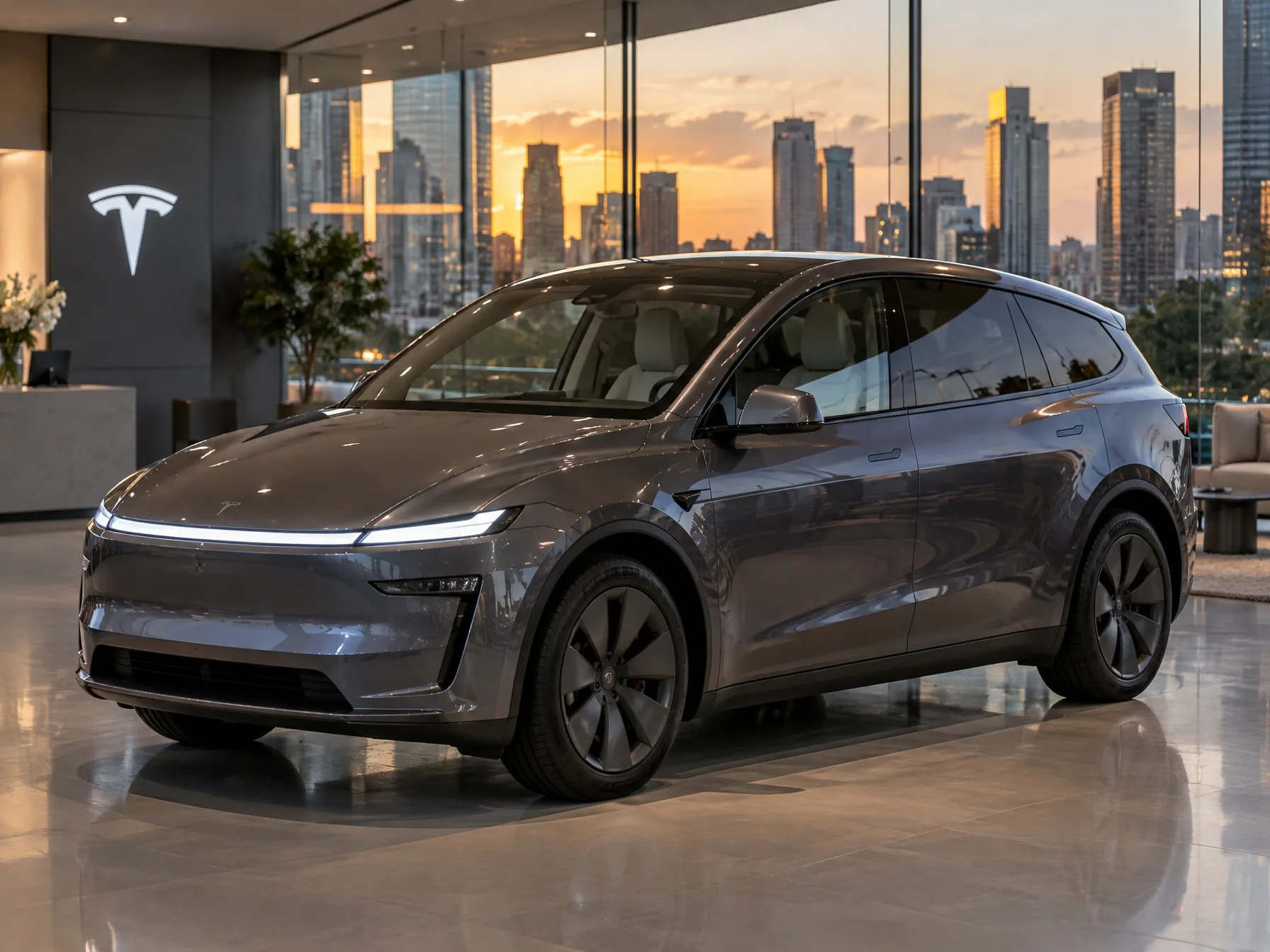
Model Y L (the "YL")
The Model Y L is Tesla's long-wheelbase, six-seat Model Y. It first launched in China in August 2025 and reached the Philippines on 25 March 2026, making us the third market outside China after Australia and Thailand. It comes in a single trim, Premium AWD, at an indicative ₱2,849,000, and it received DOE recognition at launch.
What you actually get for the extra length:
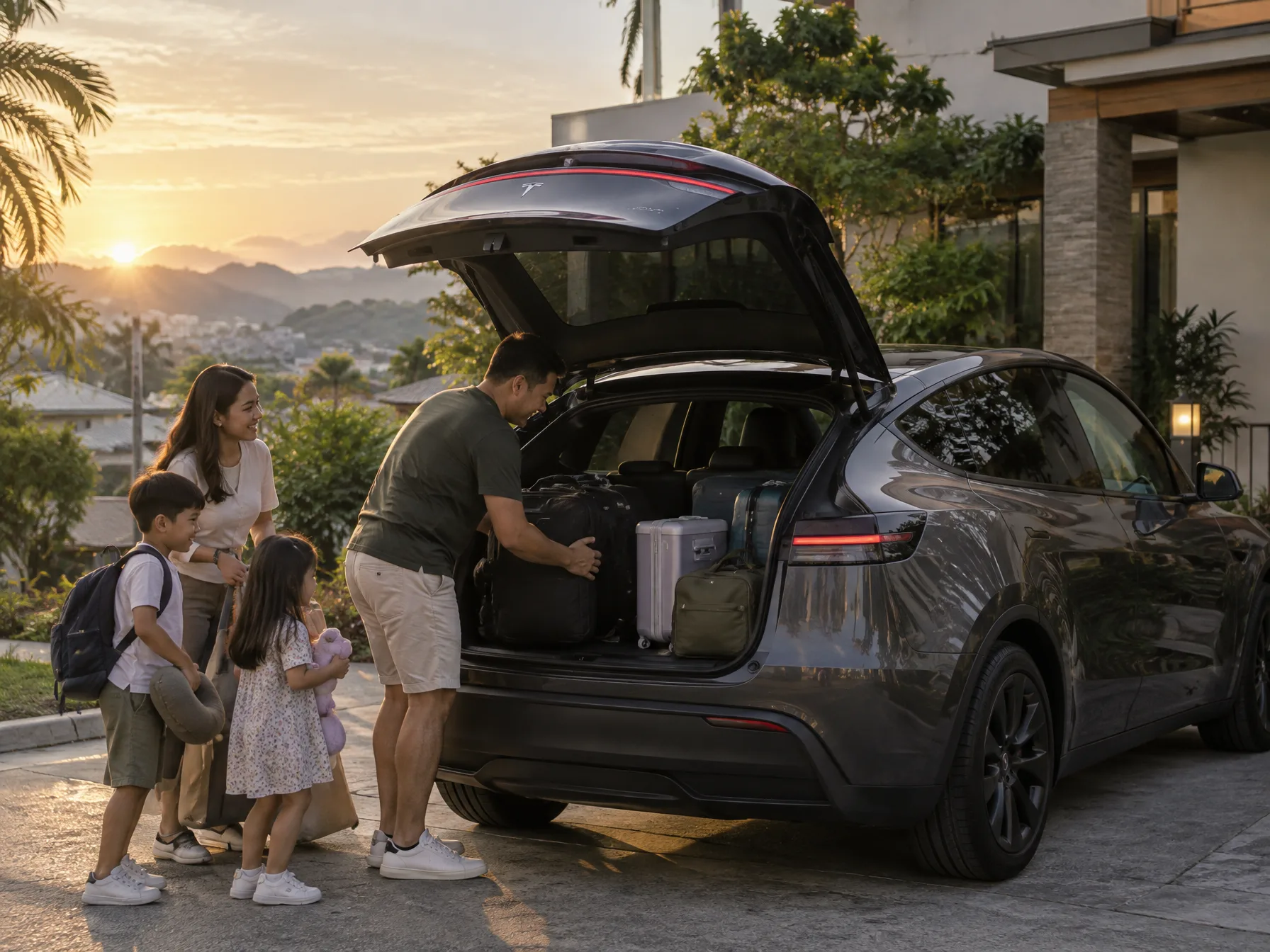
- Six seats in a 2-2-2 layout. Two captain's chairs in the middle row give each passenger their own space and a clear walkway to the third row. This is the difference between "five seats and a squeeze" and a proper family vehicle.
- Dimensions. Reported at 4,969 mm long, 1,920 mm wide and 1,668 mm tall, with a longer wheelbase than the regular Model Y (about 186 mm longer overall, per Top Gear). Ground clearance is reported at 169 mm and curb weight at about 2,088 kg.
- Cargo. Up to 2,539 liters with the rear seats folded, according to ZigWheels.
- Power and charging. Dual-motor AWD, about 514 hp, 0-100 km/h in roughly 4.5 to 5 seconds (sources differ), and a reported 288 km of range added in 15 minutes on a Supercharger.
- Comfort tech. A 16-inch front touchscreen, a dedicated 8-inch screen for second-row passengers, 19 speakers, and 19-inch Machina 2.0 wheels.
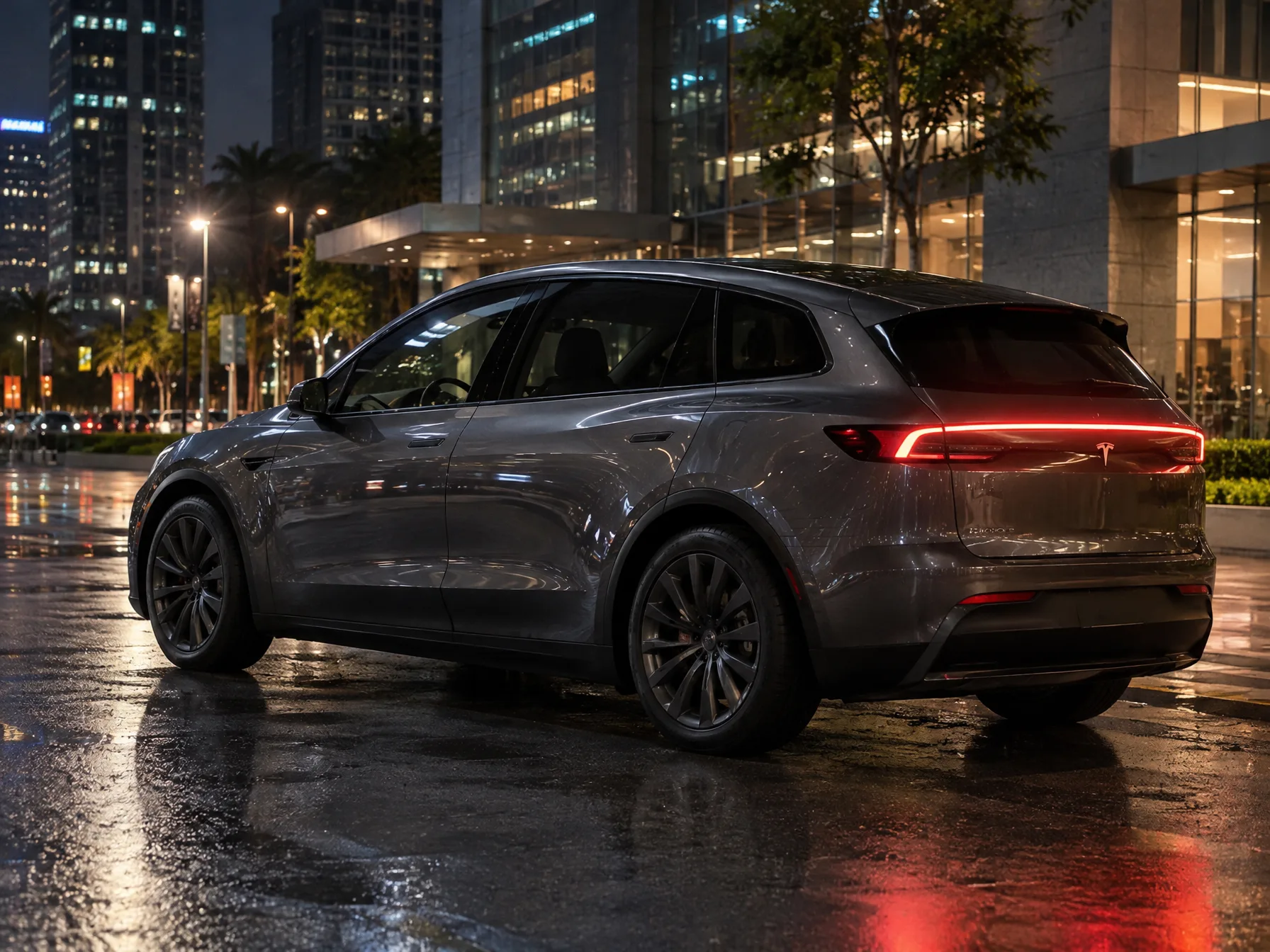
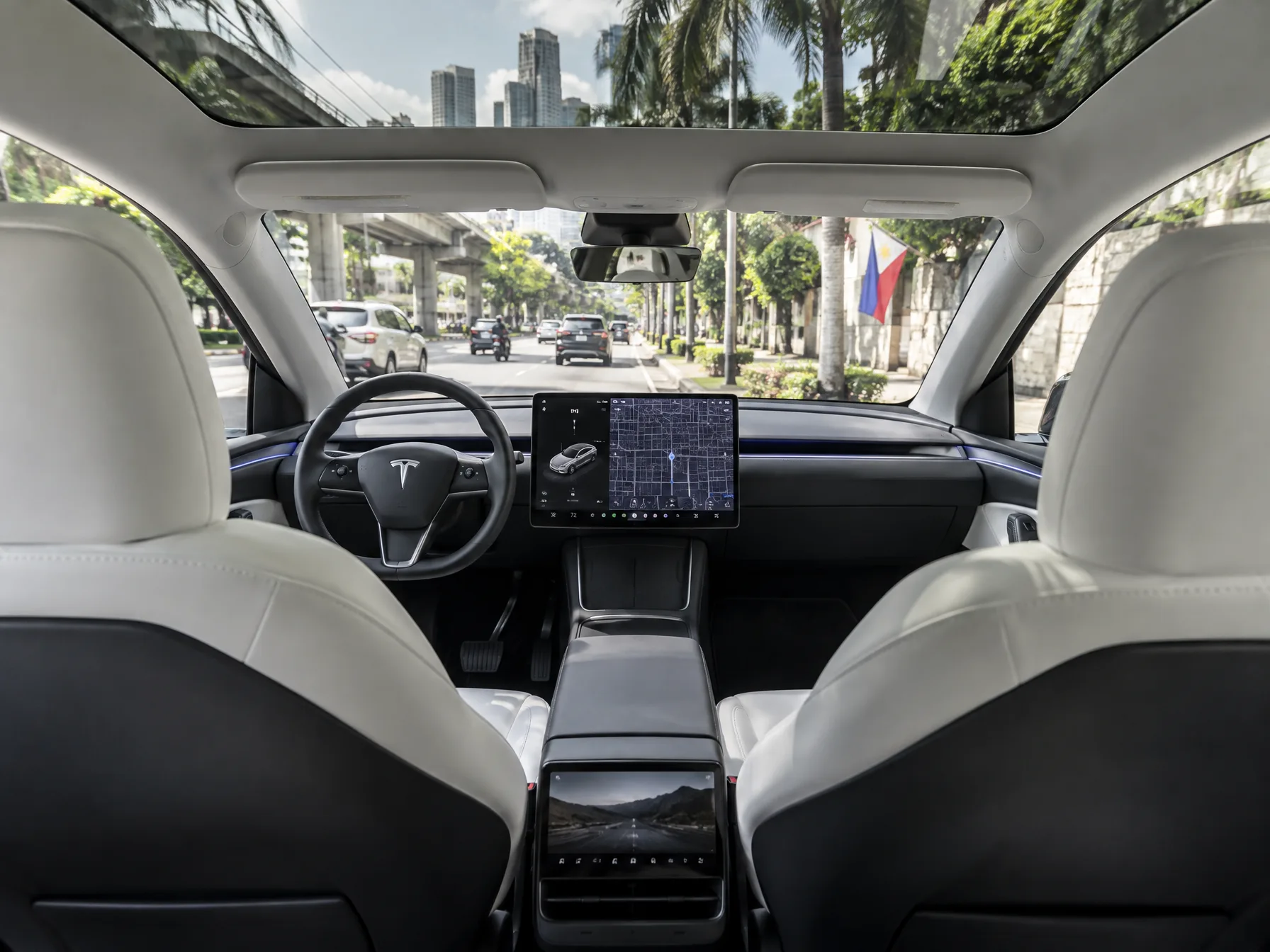
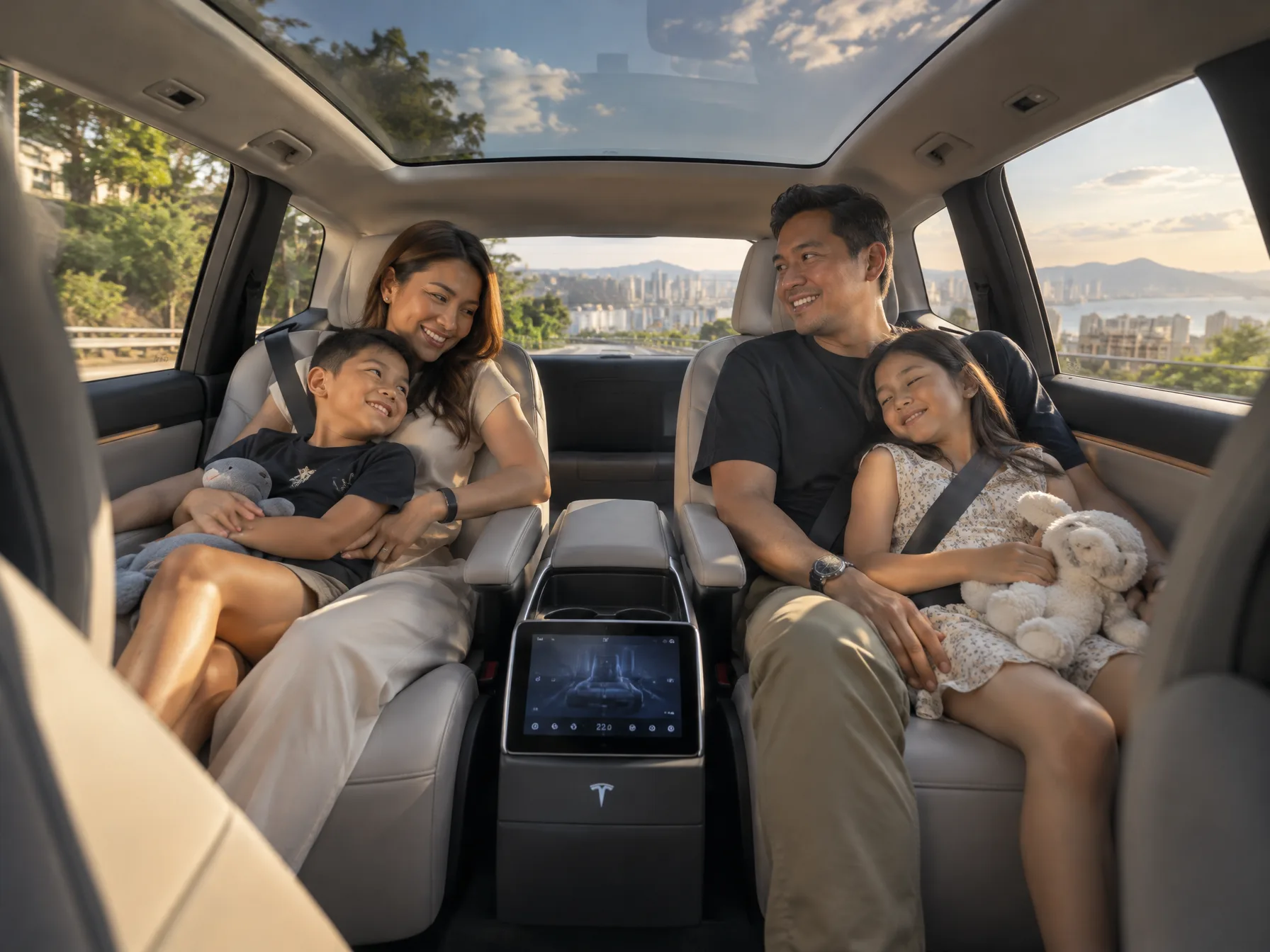
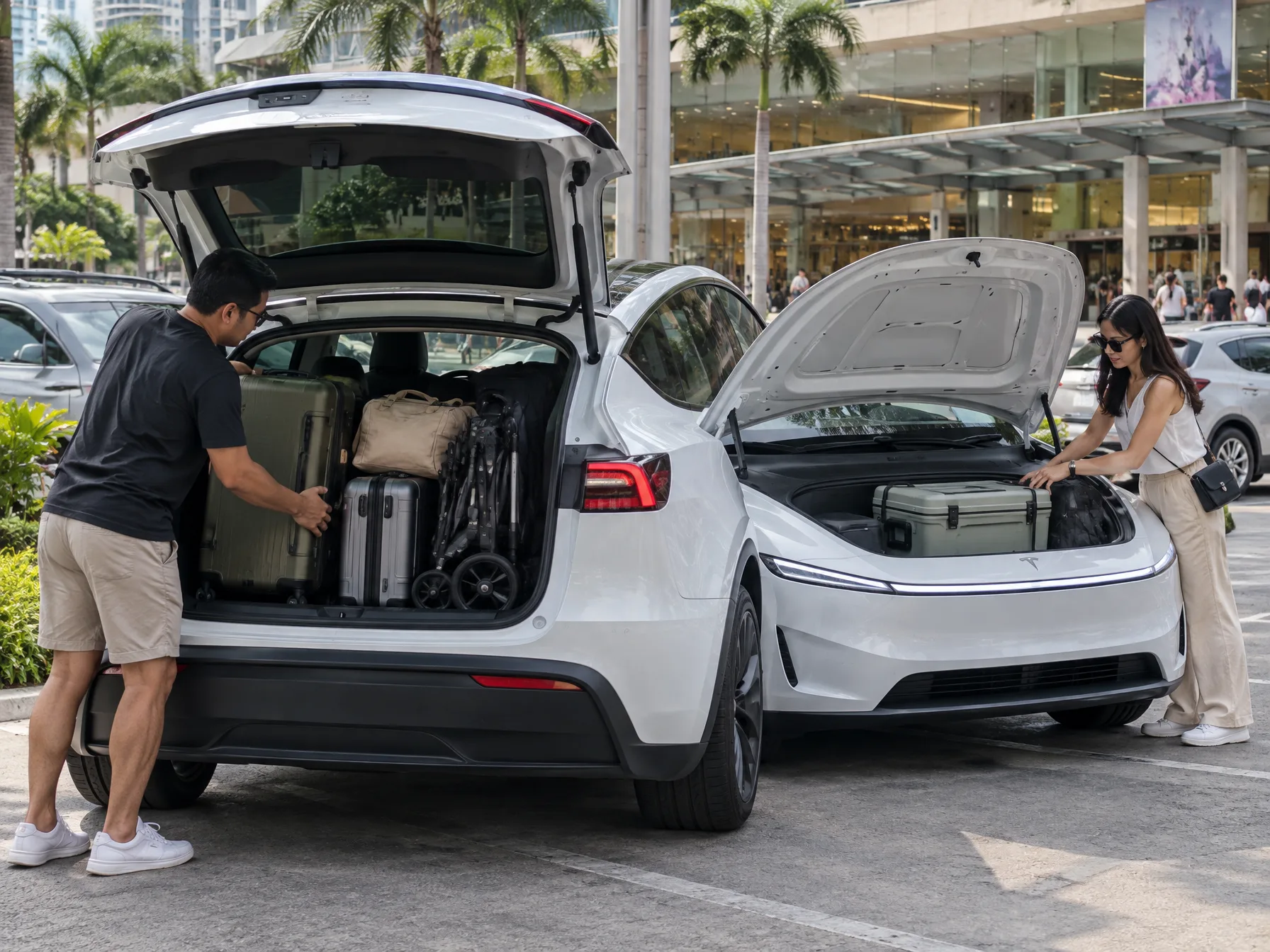
Who is it for? Three groups stand out. First, families with two or more kids (or grandparents) who currently drive a seven-seat SUV or MPV and want to stop paying for gasoline. Second, road-trippers who regularly do Manila to Baguio, Tagaytay, Subic or La Union runs and want a car that handles highway distances without anxiety. Third, premium TNVS and executive-transport operators: the second-row screen, quiet cabin and low running cost suit that work well. A fair warning: if you mostly drive solo in Metro Manila and never need more than five seats, the Model Y Long Range may be the better value.
Not sure which variant fits? Use the comparison tool below to line up any two or three trims side by side.
Build your Tesla
Pick a model, paint, wheels, seating and driver-assist package, and watch the indicative total update. The configurator below uses the Philippine prices reported by local media and is meant for planning; the binding quote always comes from Tesla's own order page.
How to order a Tesla in the Philippines
- Choose your trim online. Configure and order at tesla.com/en_ph. Model Y L orders opened on 1 April 2026.
- Pay the reservation deposit. The deposit is reported at ₱15,000 and is described as non-refundable, so be sure of your trim before you click.
- Sort out financing if you need it. One reported example for the Model Y L is a down payment of ₱569,800 and roughly ₱48,876 a month over 60 months. Treat that as an illustration, not an offer; rates vary by bank.
- Wait for delivery. Reported lead time is about 2 to 3 months, although CarGuide noted in May 2026 that Model Y L deliveries began within a month of orders opening.
- Insurance. Tesla has been reported to include one year of complimentary comprehensive insurance for Model Y buyers. Check whether the promo is still running and what it covers when you order.
- Take delivery at the Tesla Center. Deliveries are handled at Tesla Center, Uptown Parade, BGC. Bring valid IDs and your insurance and registration documents.
- Set up home charging. Tesla Philippines has been reported to offer a free Wall Connector to new buyers. See the home charger section for what your electrician needs to do.
Warranty, as reported: 4 years or 80,000 km basic, and 8 years or 192,000 km on the battery and drive unit.
Colors and options
| Option | Price (₱) | Notes |
|---|---|---|
| Pearl White Multi-Coat | Included | Standard paint |
| Diamond Black | +66,000 | |
| Stealth Gray | +99,000 | |
| Glacier Blue | +99,000 | |
| Quick Silver | +146,000 | |
| Ultra Red | +146,000 | |
| Cosmic Silver | Model Y L exclusive | Paint on the Model Y L is reported at ₱66,000 to ₱146,000 depending on color |
| Zen Gray interior (Model Y L) | +66,000 | Lighter cabin |
| Enhanced Autopilot | +197,000 | Adds features like Summon |
| Full Self-Driving Capability | +394,000 | See the honesty box below |
| Mobile Charger Kit | ~34,800 | Third-party retailer price |
Paint and package prices from CarGuide. Model Y paint list reported in January 2026; confirm on the order page.
An honest word on Autopilot and FSD. Basic Autopilot (traffic-aware cruise control and lane keeping) is standard. Tesla Philippines sold an FSD Capability package as a one-time ₱394,000 purchase, with a reported deadline of 30 June 2026 before a move to subscription pricing. But media reports say the feature is not available for use in the Philippines, and we found no evidence that FSD (Supervised) has been activated here as of October 2026. If you are buying purely for self-driving, do not count on it. If you are buying for the car, the range, the charging and the software, you will not miss it.
Price comparison: top 10 EVs in the Philippines
Where does Tesla sit in the wider market? The chart below lines up ten of the most relevant battery-electric models on sale in October 2026 by price, range and estimated running cost. Click through the metrics to re-sort.
What your pesos buy at each tier
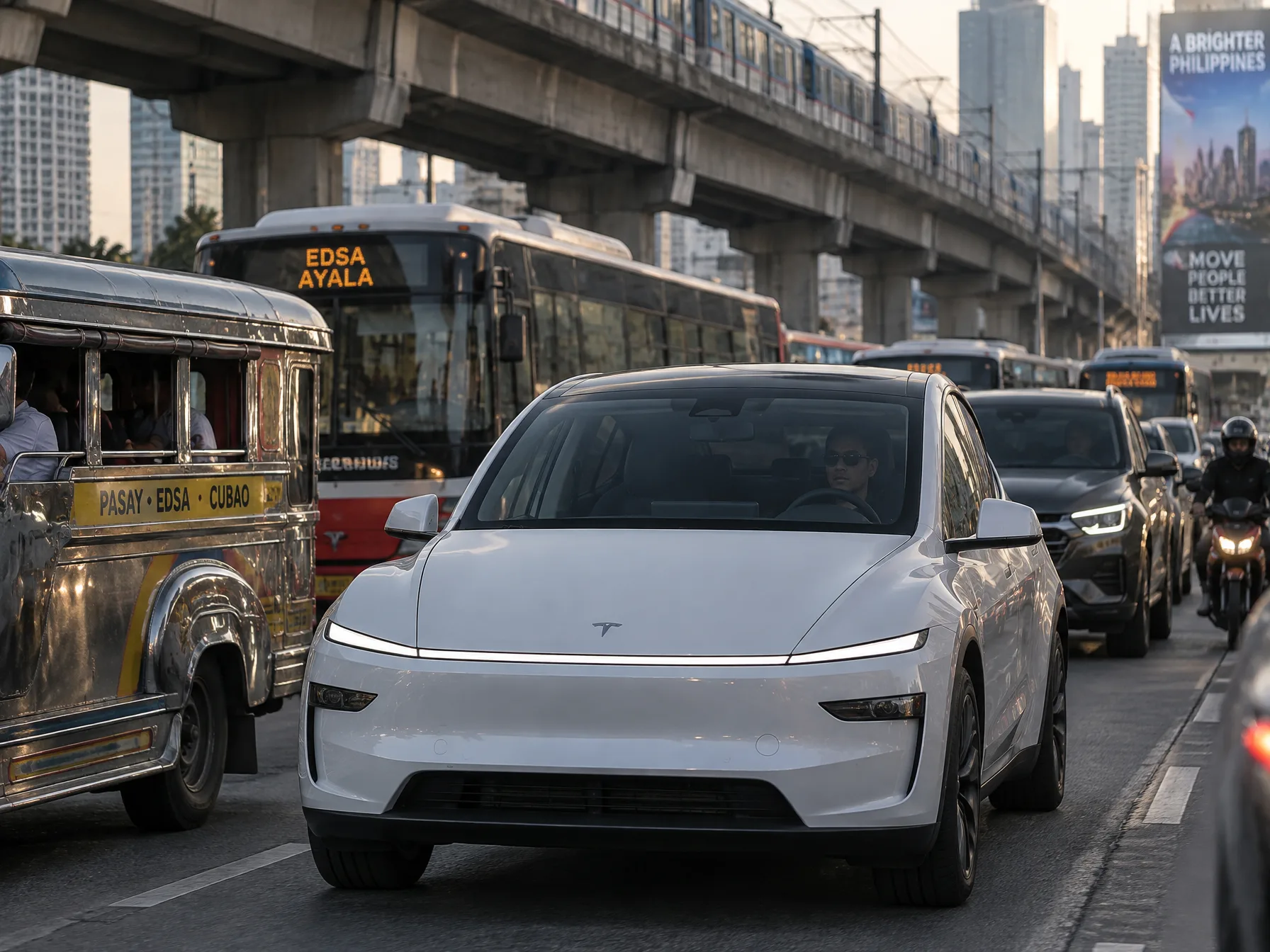
- Under ₱1 million. BYD Seagull (₱968,000) and VinFast VF 3 (₱745,000) are city cars. Fine for short trips and second-car duty, with rated ranges of roughly 210 to 305 km on marketing cycles.
- ₱1.4 to ₱1.8 million. The mainstream battleground: BYD eMAX 7, Atto 3, VinFast VF 6, MG S5, Jaecoo EJ6, Geely EX5 and the Tesla Model 3 Standard (₱1,838,000). Ranges run from about 340 to 480 km on mixed test cycles.
- ₱2.3 to ₱2.9 million. Premium territory: Model Y trims, the Model 3 Long Range, BYD Seal and Sealion 7, and the Model Y L. This is where Tesla's range, software and charging network start paying off.
- ₱3 million and up. Performance cars: Model 3 Performance, Model Y Performance, BYD Han and Tang.
Value per kilometer of range
Divide price by rated range and a pattern emerges. The Model Y L works out to roughly ₱4,200 per rated kilometer (₱2,849,000 over 681 km). The BYD Seagull is cheaper per kilometer at roughly ₱3,200, but it is a different kind of car. The Model Y Standard RWD comes in near ₱5,200, and the Model 3 Standard near ₱3,600. Among full-size, premium, long-range vehicles, the Model Y L is one of the better deals per kilometer, which is a point Tesla's critics tend to overlook. Remember too that cycles differ, so treat these as rough guides rather than lab-grade comparisons.
How we ranked these. No official model-level BEV sales ranking exists in the Philippines: the industry body CAMPI-TMA does not include BYD, and VinFast does not publish monthly model figures. Ranks 1 to 3 are backed by partial sales evidence; ranks 4 to 10 are editorial estimates based on brand volume and availability. Prices were collected on 8 October 2026 from AutoDeal and ZigWheels and may differ from dealer quotes. Range figures use different test cycles (NEDC, CLTC, WLTP), so they are not directly comparable.
Tesla vs BYD: an honest market snapshot
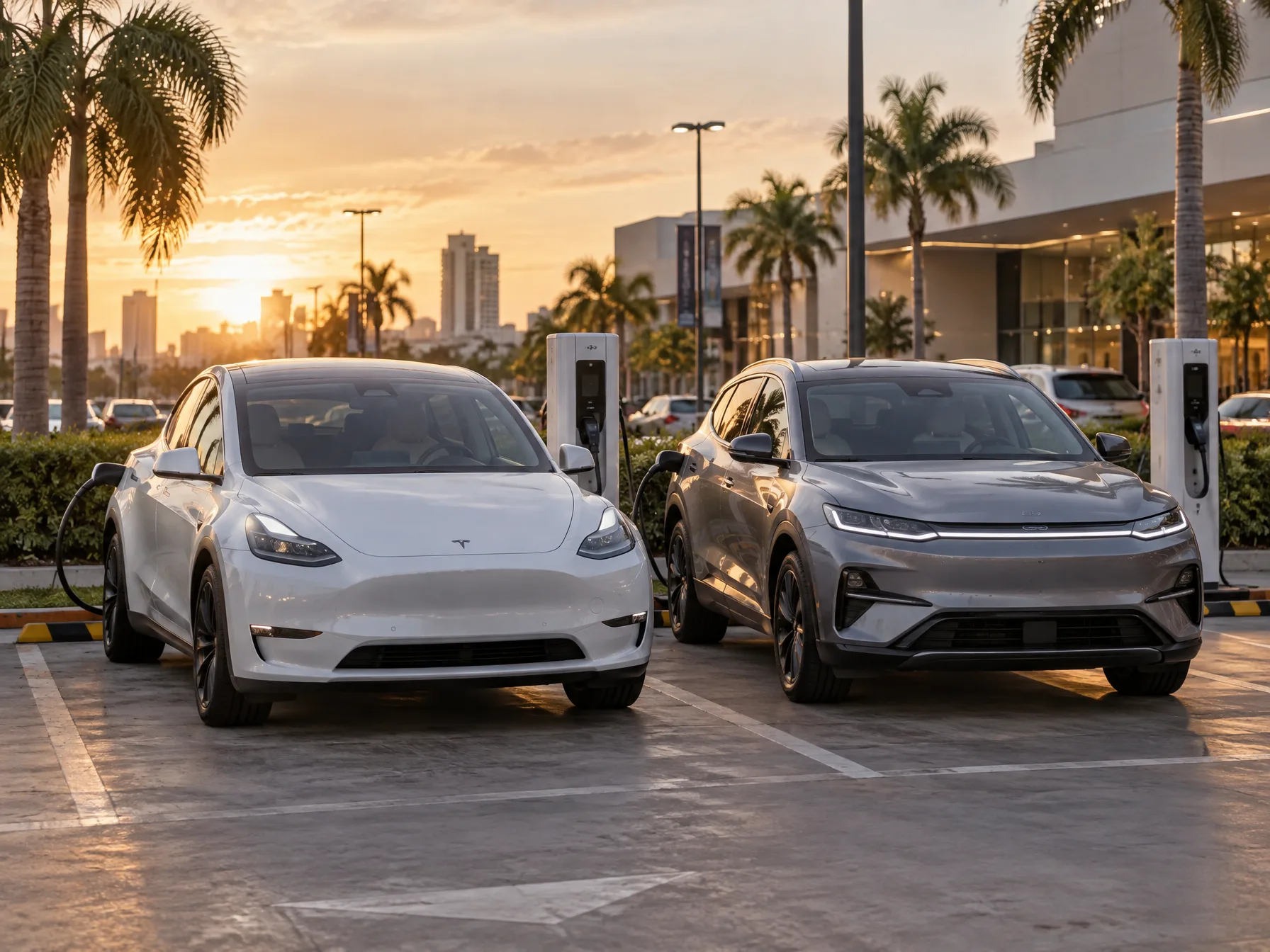
You will often hear that "BYD and Tesla are the top two EV brands in the Philippines." That is not quite right, and we would rather give you the real picture. BYD is the volume leader overall, VinFast has overtaken Tesla in battery-electric units this year, and Tesla was the number-one BEV brand for all of 2025 and for individual months in 2026.
| Brand | BEV units, Jan-Aug 2026 | Notes |
|---|---|---|
| BYD | ~5,844 | BYD's own data; BYD reports 28,399 total units including PHEVs (22,555 DM-i plug-in hybrids). Not a CAMPI member. |
| VinFast | 4,552 | CAMPI-TMA |
| Tesla | 2,872 | CAMPI-TMA. Tesla sold 2,424 units in 2025, when it led BEV sales. |
| Omoda & Jaecoo | 1,844 | As reported by CAMPI-TMA |
Sources: ZigWheels, CarGuide, Top Gear Philippines. Tesla delivered 984 units in June 2026 alone, the top BEV brand that month.
Use the head-to-head tool below to compare specific models.
Model Y vs Sealion 7, Atto 3 and Seal
| Model | Price (₱) | Battery | Range (as reported) | Power | Seats |
|---|---|---|---|---|---|
| Tesla Model Y Standard RWD | 2,369,000 | ~60 kWh | 455 km WLTP | 295 hp | 5 |
| Tesla Model Y Long Range AWD | 2,749,000 | 81 kWh | 533 km WLTP | 384 hp | 5 |
| Tesla Model Y L | 2,849,000 | 88.2 kWh | 681 km WLTP | ~514 hp | 6 |
| BYD Sealion 7 | 2,588,000 | 82.5 kWh | 567 km | 523 hp | 5 |
| BYD Seal | 2,098,000 to 2,648,000 | 61.4 to 82.6 kWh | ~510 to 580 km NEDC | 200 to 522 hp | 5 |
| BYD Atto 3 | 1,638,000 to 1,848,000 | 49.9 to 60.5 kWh | 410 to 480 km NEDC | — | 5 |
The Sealion 7 is about ₱219,000 above the Model Y RWD and roughly ₱100,000 to ₱160,000 below the Model Y Long Range AWD, depending on which list price you use. BYD range figures are mostly NEDC, which is more generous than WLTP.
Where Tesla wins
- Charging network. Tesla Superchargers (up to 250 kW, ₱19 per kWh) are tightly integrated with the car's navigation, which preconditions the battery on the way and shows live stall availability.
- Over-the-air software. Features, efficiency tweaks and the interface improve after purchase, with updates arriving roughly monthly, plus larger seasonal releases.
- Efficiency. Rated consumption of about 13 kWh per 100 km for the Model Y L is excellent for an 88 kWh, six-seat AWD car.
- Brand and resale. Tesla is the recognisable name in used-EV conversations globally. We could not find Philippine used-EV data, so we will not claim a number, but strong brand pull generally helps resale.
- Safety tech. Standard Autopilot features, a camera suite, Sentry Mode and over-the-air safety updates.
- Model Y L space and range. Six seats and 681 km WLTP is a combination BYD does not currently sell in this price class, though the eMAX 7 competes in seven-seat territory at a much lower price and shorter range.
Where BYD wins
- Price. The Seagull starts at ₱968,000 and most BYD models undercut their Tesla equivalent by hundreds of thousands of pesos.
- Dealer reach. BYD reports 81 dealerships nationwide through Ayala's AC Mobility. Tesla's physical footprint is far smaller, centered on Tesla Center BGC.
- PHEV options. BYD's plug-in hybrids (DM-i) are five times as popular as its BEVs, because they remove any range worry.
- Entry models. Nobody else has a sub-₱1 million BEV with BYD's volume behind it.
- Warranty bundle. BYD reports 6 years or 150,000 km on the vehicle and 8 years on the battery; Tesla's reported battery and drive unit cover is 8 years or 192,000 km.
Our verdict. If your budget is ₱1 to ₱1.7 million, BYD (and VinFast) are the practical answer, and we would not talk you out of them. If you can afford ₱2.4 million or more, the comparison changes: you are no longer buying the cheapest EV, you are buying the best-integrated one. At that level the Tesla's charging network, software, efficiency and (in the Model Y L's case) space and range make it the car we would choose.
Running cost per 100 km
| Vehicle | Estimated cost per 100 km (home charging) |
|---|---|
| BYD Seagull | ~₱160 |
| BYD Seal (Advanced) | ~₱195 |
| BYD Atto 3 (Premium) | ~₱204 |
| Tesla Model Y L | ~₱210 |
| Tesla Model Y RWD | ~₱217 |
| BYD Sealion 7 | ~₱236 |
| Tesla Model Y Long Range | ~₱238 |
| Gasoline crossover (RON 95 at ₱96.03/L, 10 to 12 km/L) | ~₱800 to ₱960 |
Our calculation: rated battery size divided by rated range, plus 10% charging loss, at Meralco's September 2026 overall rate of ₱14.7424 per kWh (October's rate was not yet announced as of 8 October 2026). Real-world use can be 15% to 25% worse than rated, and gasoline mileage is our assumption. Supercharger charging at ₱19 per kWh costs more than home charging.
Government incentives for EVs
The Philippines does offer meaningful perks to EV buyers, but they come from several laws with different expiry dates, and some commonly repeated "benefits" (like free parking) are only proposals. The timeline below walks through what is law, what is pending and what has happened in 2026.
The timeline in plain English
- 2018 (TRAIN Law). Purely electric vehicles are exempt from the automobile excise tax, which on a regular car can reach 20% on a price between ₱1 million and ₱4 million. Hybrids pay half the rate.
- 13 January 2023 (EO 12). Import duty on built-up electric vehicles cut to 0% for five years.
- 2022 (RA 11697, EVIDA). The Electric Vehicle Industry Development Act became law in April 2022, setting the framework for registration discounts, number-coding exemption, priority registration and special plates, with most of these set for eight years from effectivity.
- 20 June 2024 (EO 62). The 0% tariff schedule was extended and widened (including hybrids and parts) through 2028; the end date is commonly quoted as 31 January 2028.
- October 2025. The DOE clarified that EVs and hybrids are automatically exempt from number coding under EVIDA, with no separate DOE certification needed, after confusion following a PNP-HPG statement.
- July 2026. An executive order created the EV Incentive Strategy (EVIS), reported at up to ₱60 billion of fiscal support for local EV manufacturers. It helps makers, not buyers, but it points toward locally built EVs in the longer run.
What you get today
| Benefit | Status as of Oct 2026 | Expiry or caveat |
|---|---|---|
| Import duty on built-up BEVs | 0% | Through 2028 unless extended |
| Excise tax on BEVs | Exempt (hybrids pay half rate) | No sunset found in the law; vehicle must be on the DOE EV recognition list |
| Registration, MVUC and inspection fees | 30% discount for BEVs (15% for hybrids), per EVIDA | About eight years from EVIDA's effectivity, i.e. around 2030 |
| Number-coding exemption | Yes | Around 2030; confirm with your LGU/MMDA if challenged |
| Priority registration and special plate | Yes | Around 2030 |
| VAT | 12% still applies; we found no EV exemption | - |
| Free or discounted parking, toll-free EV lanes | Not law yet | Only proposed in a pending Senate bill |
Basis: RA 11697 (EVIDA), EO 12, EO 62. Implementation details can vary at the LTO and LGU level; verify with the relevant office before you rely on a specific discount.
What may come next
- EVIDA extension bills. A Senate bill filed in July 2026 (SB 2270) would extend EVIDA incentives from 8 to 12 years, which would push the tariff benefit toward 2034, and add perks like parking discounts and toll-free EV lanes. Other House bills have proposed longer 0% tariffs. As far as we could tell, these are still bills; their committee status is unclear.
- Tariff extension study. In mid-September 2026, a Trade undersecretary said the government is studying an industry request to extend the 0% tariff to 2040, while also considering different treatment for EVs versus hybrids. No decision has been reported. If nothing is extended, duties on built-up EVs could revert to 20% to 30% after the current schedule ends, which is one reason some buyers are moving sooner rather than later.
- Charger targets (and a conflict). You will see two different goals for charging stations by 2028: 65,000 and 7,300. The 65,000 figure is the one widely reported from the DOE's 2023 EV roadmap, which also targets about 2.45 million EVs (including motorcycles and tricycles) by 2028. The 7,300 figure shows up in some other reports. We could not reconcile the two, so treat 65,000 as the headline DOE goal and note that actual public stations were reported at about 800 mapped in June 2026. Either way, charging is growing but far from the target.
- Parking rules. The DOE is preparing a circular on a provision requiring dedicated EV charging slots (5% of spaces in larger buildings built after the law took effect). This is about charger availability, not free parking.
- Local manufacturing. Under EVIS, enrolled manufacturers must bring a locally built EV to market within three years of registration, so realistically late decade at the earliest.
Timing tip. The big question for buyers is the 2028 tariff date. If your plan is to buy in the next year or two, today's perks apply; if you are waiting for a price drop, watch the extension decision closely, because it could move prices either way. This is general information, not tax or legal advice.
Charging in the Philippines: what Tesla supports, where to plug in, and what is coming
Charging is the question every first-time EV buyer asks, and for Tesla owners the honest answer is: very good in Metro Manila, workable on the main Luzon expressways, and still thin once you leave the highways. Here is exactly what plugs into what, how long it takes, and where the network is heading.
The plugs a Philippine-spec Tesla can use
Tesla vehicles sold here (Model 3, Model Y and Model Y L) use the CCS2 / Type 2 inlet that is standard across Europe, Australia and much of Asia. That is good news: you are not locked into one brand's plugs, and no NACS adapter is needed or relevant in the Philippines. Reported specs point to an 11 kW onboard AC charger, and the same physical port takes DC fast charging.
- Type 2 AC, up to 11 kW onboard. This is what your home Wall Connector, a Tesla destination charger and most mall chargers use. The car's onboard charger converts AC to DC, so the wall unit only needs to be a safe, smart "switch".
- CCS2 DC fast charging. The inlet takes CCS2 DC from any compatible station. At Tesla's own V4 Superchargers, power is up to 250 kW. At third-party stations, power is limited by whichever is lower, the charger or the car.
- Mobile Connector. A portable cable-with-control-box that plugs into a suitable outlet. Tesla's Mobile Connector kit is reported at about ₱34,800 at a third-party retailer; check Tesla for current pricing and which adapters are bundled in the Philippines.
- Wall Connector. The wall-mounted home unit, rated up to roughly 11.5 kW (48 A) in Tesla's generic specs. Tesla Philippines has been reported to give new buyers a Wall Connector at no charge (more in the home charger section).
- Not compatible: CHAdeMO and GB/T DC chargers. A few older or Chinese-standard stations in the Philippines carry those plugs. If a station lists only CHAdeMO or GB/T, skip it.
Rule of thumb: look for the words CCS2 (DC) or Type 2 (AC). If you see those, your Tesla can physically plug in. Then check the live status and price in the Tesla app or the charger's own app.
Charging levels compared, with the math
Charging speed is just energy divided by power. For a Model Y with the roughly 81 kWh battery of the Long Range AWD, going from 10% to 80% means adding 70%, about 56.7 kWh (0.70 x 81). For the Model Y L's 88.2 kWh pack the same 70% is about 61.7 kWh. Divide by the charger's power and you get the ideal time. Real sessions are a bit longer because of conversion losses (roughly 8-12% on AC), cold or hot batteries, and the way DC power tapers off as the battery fills.
| Charging level | Typical use | Ideal time 10-80% (81 kWh pack) | Range added per hour* |
|---|---|---|---|
| AC 7 kW (many mall chargers, 7.4 kW) | Parked for hours: malls, hotels, condo | 56.7 / 7 = about 8.1 h (plan 9 h with losses) | about 40-45 km |
| AC 11 kW (home Wall Connector, Tesla destination) | Overnight at home, long dinners | 56.7 / 11 = about 5.2 h (plan 5.5-6 h) | about 65-71 km (Top Gear reports ~71 km/h at destination chargers) |
| DC 50 kW (older public DC) | Highway top-up in a pinch | 56.7 / 50 = about 1.1 h (plan 1.3 h) | about 250 km/h of charging, tapering |
| DC 150 kW (AC Mobility and similar fast hubs) | Highway stops | 56.7 / 150 = about 23 min ideal (plan 30 min) | about 700 km/h peak equivalent, tapering |
| DC 250 kW (Tesla V4 Supercharger) | Fastest charging available to a PH Tesla | 56.7 / 250 = about 14 min if power never tapered; expect about 20-25 min | Tesla-cited examples: 267 km in 15 min (Model Y LR), 288 km in 15 min (Model Y L) |
*Range-per-hour values are our rough estimates at about 16 kWh/100 km. Peak DC power only holds for part of a session and depends on battery temperature and state of charge. The 15-minute figures are as quoted by Tesla and the media, not independent tests.
Two practical takeaways. First, for daily life you will almost never need DC. A typical 40 km commute uses about 6-7 kWh, which an 11 kW home charger refills in under an hour. Second, DC fast charging is a road-trip tool: arrive at 10-20%, leave at 70-80%, because the last 20% is slow and not worth waiting for.
Tesla's network today
4Supercharger sites
16Supercharger stalls
250 kWV4 peak power
₱19per kWh at Superchargers
₱16per kWh at destination chargers
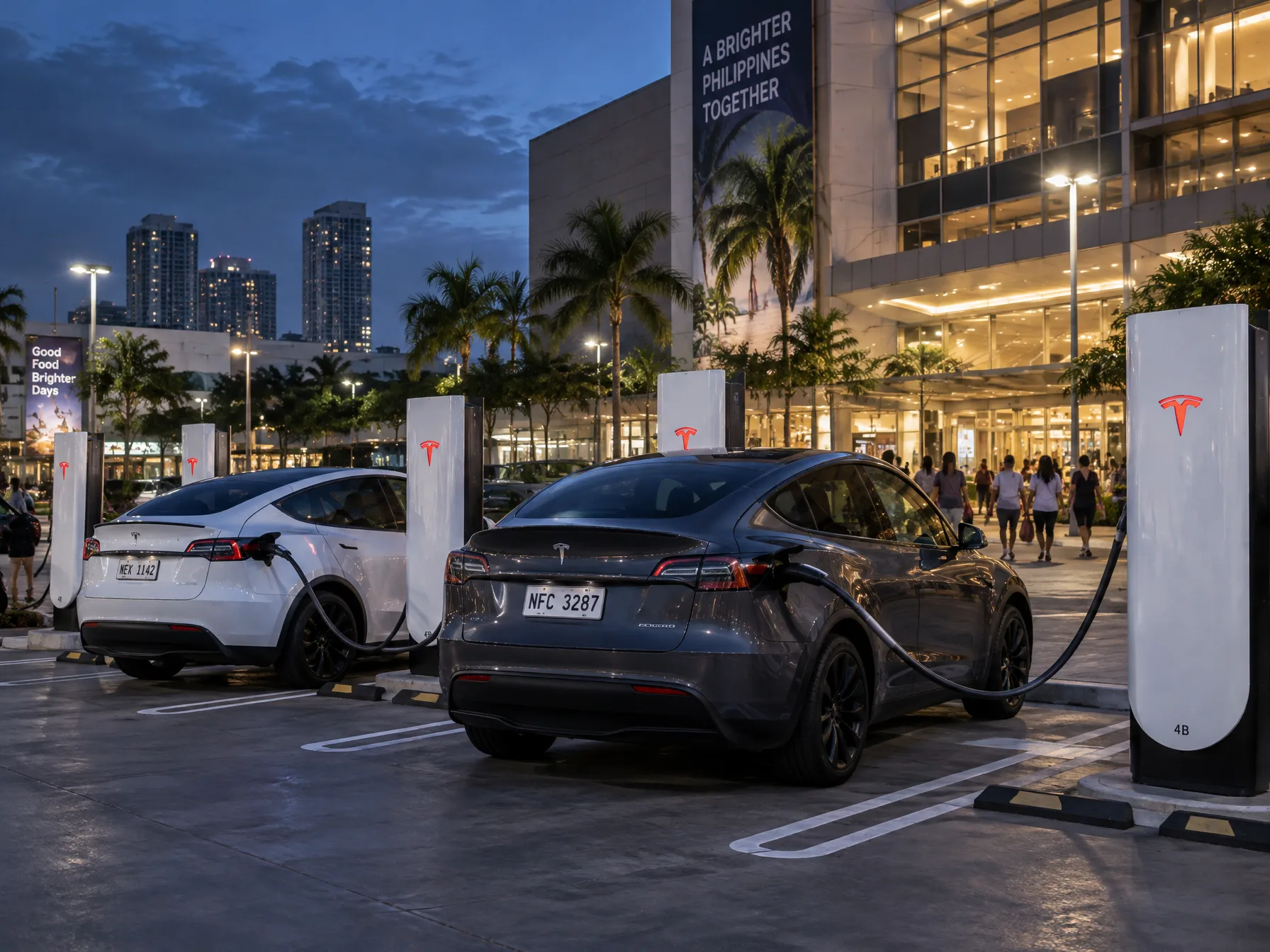
Superchargers (4 sites, 16 stalls, all in Metro Manila): Uptown Mall in BGC (the first, December 2024), SM Mall of Asia in Pasay, Shangri-La Plaza in Mandaluyong (B1 East Wing) and Opus Mall in Quezon City (opened February 2026). Each is reported at four stalls, V4 hardware and up to 250 kW. They are Tesla-only. Pricing is about ₱19/kWh, which is cheaper than the ₱35/kWh some third-party DC stations charge, though still more than home electricity.
Destination chargers (AC, 7-11 kW): these are slower and cheaper, reported at about ₱16/kWh (2025 pricing), typically four connectors per site. Outlets disagree on the count: early 2026 reports said 6 sites (24 connectors), newer reports say 10 sites (40 connectors), and the sites we can name individually number nine. We list the named ones in the malls section. Treat any single number as a snapshot, since Tesla keeps adding sites.
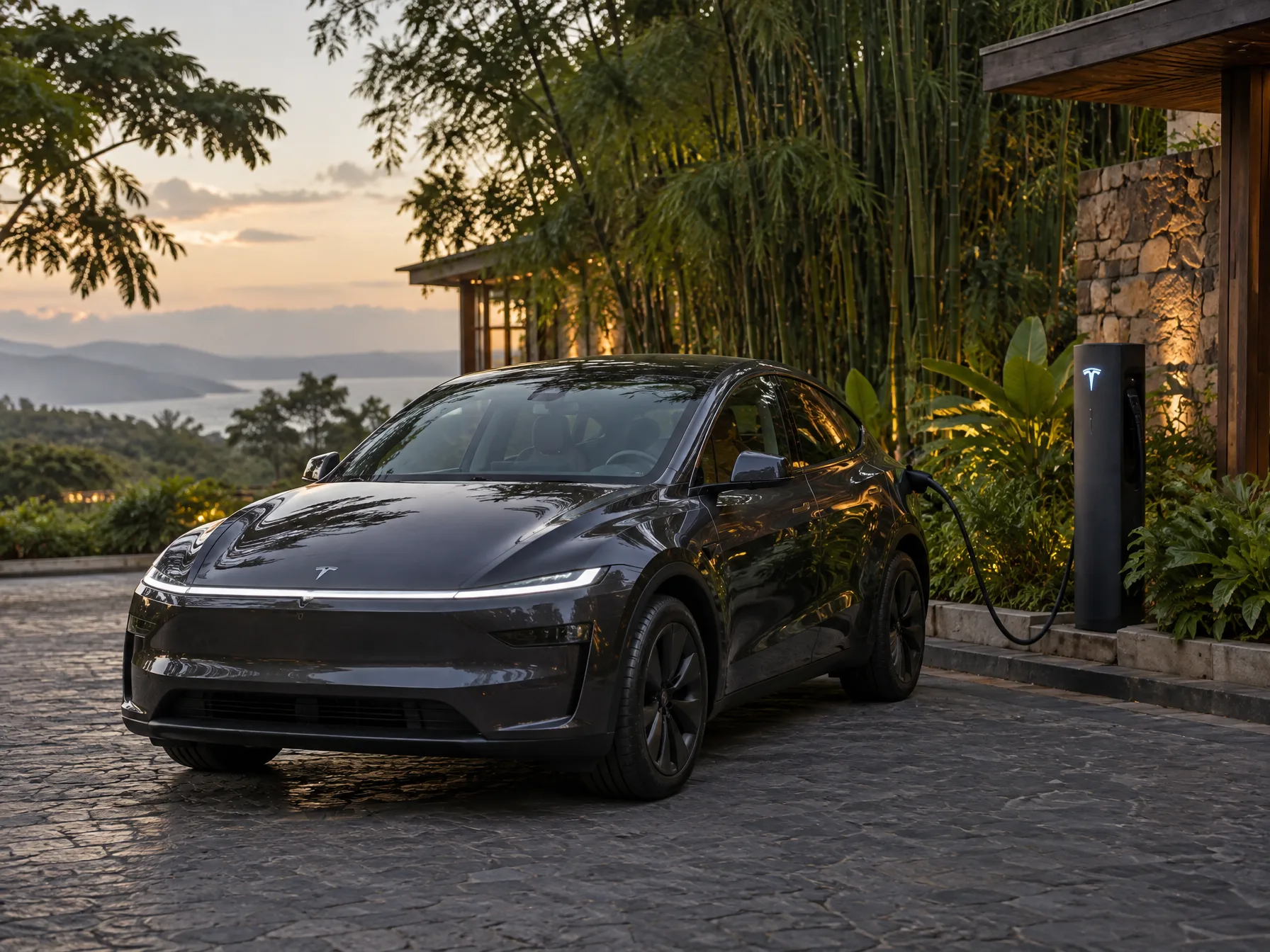
What is planned, and what to realistically expect
Tesla's Philippine channels and media coverage in October 2026 list the following as "set to open soon", with no dates announced:
- Superchargers: Baguio, Seven/Neo BGC, Paseo Center Makati, Robinsons Magnolia (Quezon City), and a site described only as "Manila".
- Destination chargers: SM City Cebu and SM Olongapo Central.
- Earlier in 2026, Tesla also talked about expanding to Cebu (two sites), Clark, Baguio, Olongapo and Taguig.
Our estimate, not Tesla's schedule: the pace so far is roughly one new Supercharger site every few months in 2025-26 (BGC in December 2024, then three more by February 2026), and destination sites arriving in small batches (Laguna and BGC in July 2026, Clark in October 2026). If that pace holds, it would be reasonable to expect the Metro Manila additions first, and the Baguio site as the first genuine "North Luzon" Supercharger sometime in the following months. Cebu looks later and is more uncertain, since it needs a separate logistics chain. Treat all of this as informed speculation and watch the Tesla app, which shows new sites as they go live.
Meanwhile, Tesla has promoted a Clark activation (2-18 October 2026) with up to 5,000 km of Supercharging credits for new reservations, and a Green Mobility Program of up to ₱50,000. Promos change, so check Tesla's Philippine site before ordering.
Other charging networks you can use
Because your Tesla has a CCS2/Type 2 port, the whole non-Tesla ecosystem is open to you:
- SM Supermalls: 160+ chargers across 73+ malls as of 31 March 2026, mostly free 7.4 kW AC with a three-hour limit. Great for mall trips, not for fast turnaround.
- AC Mobility (Ayala): the biggest third-party operator on directory listings (about 230 by one count; the company itself cites 90+ in older statements). Ayala Land and MACEA have built ultra-fast hubs in Makati reported at up to 480 kW. Reported public rates in April 2026: AC about ₱22-28.50/kWh, DC about ₱35/kWh.
- Meralco / Movem: Meralco's EV arm partners with AC Mobility, with chargers at places like Edades Tower in Makati.
- Petron Power Up: DC chargers along NLEX, SLEX and TPLEX.
- Shell Recharge / Evro: including a 180 kW unit on TPLEX at Rosario, La Union, and one on SLEX at Mamplasan.
- WeCharge, Galaxy Charge, Megaworld, Solarius, EvoXCharge, V-Green (VinFast): smaller networks, strong at hotels, resorts and specific malls. V-Green was reported free for VinFast owners until 2029, but that benefit is for VinFast cars.
Why the national numbers disagree. You will see "over 900", "1,159" and "1,600" in the news. The differences are definitional: some counts include battery-swap stations, some count charging points instead of stations, and some are Department of Energy (DOE) accreditations rather than chargers you can actually drive to. The DOE reported over 900 public stations in April 2025 and about 1,600 accredited stations (including battery swap) by the end of that month. A June 2026 directory snapshot from expressway.ph mapped around 800 public stations, 137 of them DC fast, with 311 in Metro Manila. The takeaway is the same in every dataset: roughly four in ten stations are in Metro Manila, and DC fast chargers are a small minority. The widely reported DOE roadmap target of 65,000 stations by 2028 is, on current counts, very far away.
Can a BYD or a non-Tesla use Tesla Superchargers here? We found no evidence of Tesla opening Philippine Superchargers to other brands, or of the Tesla app supporting non-Tesla cars here, as of October 2026. Assume they are Tesla-only.
Interactive charger map
The map below plots every Tesla site and third-party charger from our research, with search and filters. Positions are approximate and availability changes, so confirm in the Tesla app or the operator's app before you drive out.
Malls & places with EV chargers: Tesla-supported first
These tables list chargers verified in our research as of 8 October 2026, grouped by who runs them and where they are. "Tesla OK" means the station has a CCS2 (DC) or Type 2 (AC) connector, which a Philippine-spec Tesla can use. It is not a guarantee that the charger is working, free, or that your session will start without an app account. Verify in the Tesla app (for Tesla sites) or the operator's app, and note that coordinates and availability change.
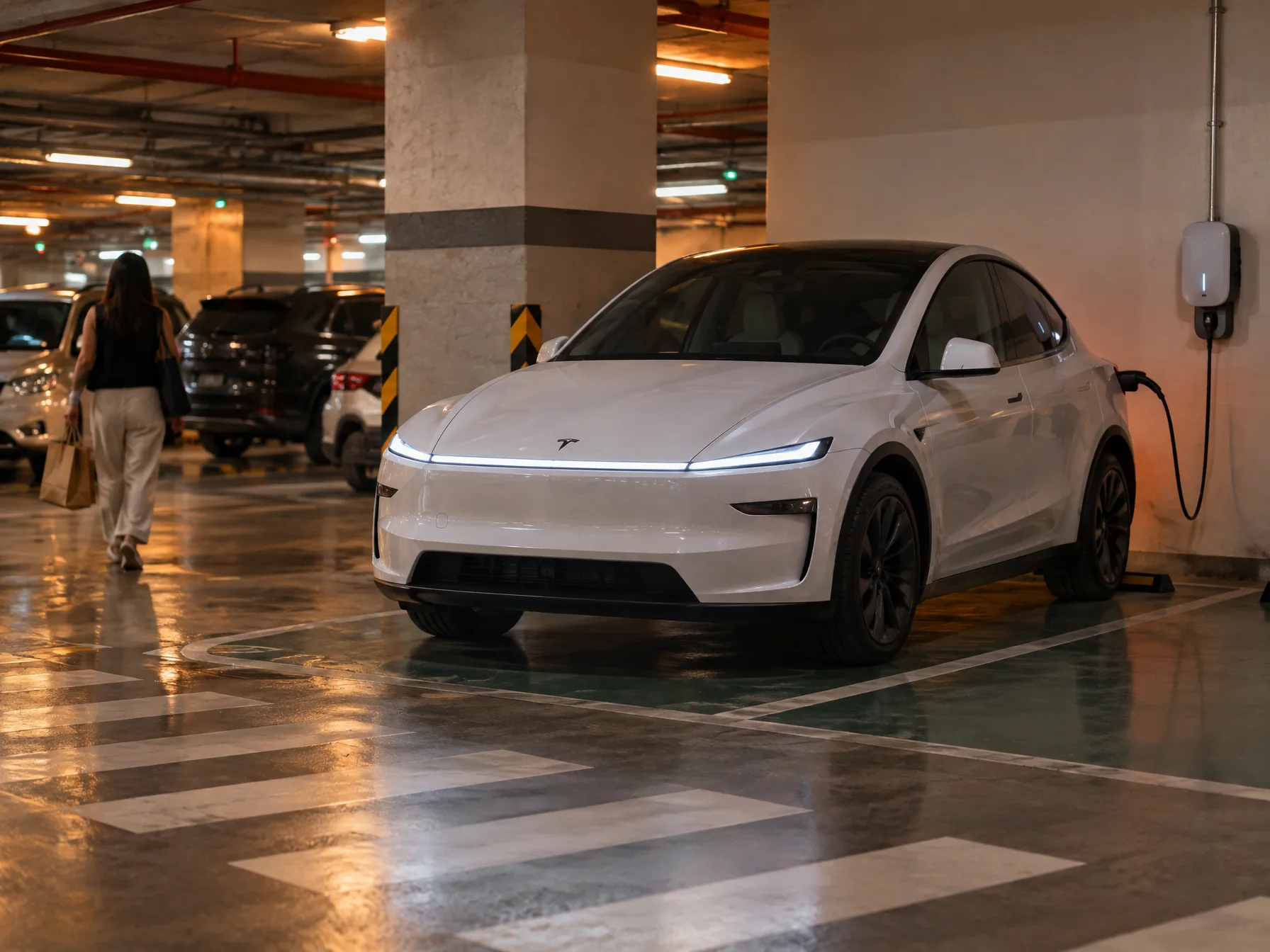
Tesla Superchargers (DC, up to 250 kW)
| Place | City | Power | Connector | Tesla OK? |
|---|---|---|---|---|
| Uptown Mall | Taguig (BGC) | 250 kW | CCS2 | Yes (CCS2) |
| SM Mall of Asia | Pasay | 250 kW | CCS2 | Yes (CCS2) |
| Shangri-La Plaza | Mandaluyong | 250 kW | CCS2 | Yes (CCS2) |
| Opus Mall | Quezon City | 250 kW | CCS2 | Yes (CCS2) |
Tesla destination chargers (AC)
| Place | City | Power | Connector | Tesla OK? |
|---|---|---|---|---|
| Eastwood Mall | Quezon City | 7-11 kW AC | Type 2 | Yes (CCS2) |
| Okada Manila | Parañaque | 7-11 kW AC | Type 2 | Yes (CCS2) |
| Vista Mall Antipolo | Antipolo | 7-11 kW AC | Type 2 | Yes (CCS2) |
| Century City Mall | Makati | 7-11 kW AC | Type 2 | Yes (CCS2) |
| Venice Grand Canal Mall | Taguig (McKinley) | 7-11 kW AC | Type 2 | Yes (CCS2) |
| 1 Roxas Boulevard | Parañaque | 7-11 kW AC | Type 2 | Yes (CCS2) |
| Arthaland Century Pacific Tower | Taguig (BGC) | 11 kW | Type 2 | Yes (CCS2) |
| Southwoods Mall | Biñan, Laguna | 10 kW | Type 2 | Yes (CCS2) |
| SM City Clark | Mabalacat/Clark, Pampanga | 11 kW | Type 2 | Yes (CCS2) |
Planned but not yet open: Superchargers in Baguio, Seven/Neo BGC, Paseo Center Makati, Robinsons Magnolia and "Manila"; destination chargers at SM City Cebu and SM Olongapo Central. See the planning notes above.
Third-party DC fast chargers
Many directory listings do not publish a kW rating. Where the table says "Not stated", expect somewhere between 30 and 120 kW unless the operator says otherwise, and check the app. CHAdeMO or GB/T plugs listed alongside CCS2 are irrelevant to you; the CCS2 gun is the one you will use.
| Place | City | Power | Connector | Tesla OK? |
|---|---|---|---|---|
| ACMobility Greenbelt 3 | Makati | Not stated | CCS2, Type 2, GB/T AC | Yes (CCS2) |
| ACMobility Corinthian Carpark / Leviste (Ayala-MACEA) | Makati | Up to 240-480 kW DC | CCS2 | Yes (CCS2) |
| ACMobility Ayala Malls Circuit | Makati | Not stated | CCS2, CHAdeMO (GET PH unit) | Yes (CCS2) |
| ACMobility Ayala Malls Manila Bay | Parañaque | 120 kW | CCS2 (+3x22 kW AC) | Yes (CCS2) |
| ACMobility Ayala Malls The 30th | Pasig | Not stated | CCS2, CHAdeMO | Yes (CCS2) |
| ACMobility Power Plant Mall (Rockwell) | Makati | Not stated | CCS2, CHAdeMO | Yes (CCS2) |
| ACMobility UP Town Center | Quezon City | 120 kW | CCS2 (+22/7 kW AC) | Yes (CCS2) |
| ACMobility Arca South / Serendra | Taguig | Not stated | CCS2, Type 2 | Yes (CCS2) |
| Uptown Mall (Megaworld CCS2) | Taguig | Not stated | CCS2 | Yes (CCS2) |
| WeCharge Hyperfast - Platinum Bldg | Quezon City | 240 kW | CCS2 + GB/T DC | Yes (CCS2) |
| WeCharge Hyperfast - NLEX Drive & Dine SB | Valenzuela | 240 kW | CCS2 + GB/T DC | Yes (CCS2) |
| Galaxy Charge - Power Fill Lingunan | Valenzuela | 60 kW | CCS2 / GB-T | Yes (CCS2) |
| SM North EDSA (GET PH) | Quezon City | Not stated | CCS2, CHAdeMO | Yes (CCS2) |
| SM Mall of Asia Boost+ / MAAX | Pasay | Not stated | CCS2, Type 2 | Yes (CCS2) |
| SM Bataan | Balanga, Bataan | 80 kW | CCS2, GB/T | Yes (CCS2) |
| SM City Baguio | Baguio | 50 kW | Reported 50 kW DC; connector varies | Check app |
| Petron Power Up NLEX KM 23 NB | Valenzuela/Bulacan | 60 kW | CCS2, CHAdeMO | Yes (CCS2) |
| Petron Power Up SLEX KM 44 SB | Calamba/Biñan | 60 kW | CCS2, CHAdeMO | Yes (CCS2) |
| Evro Shell Recharge TPLEX Rosario | Rosario, La Union | 180 kW | CCS2 (+22 kW Type 2) | Yes (CCS2) |
| Evro Shell Recharge SLEX Mamplasan | Biñan, Laguna | Not stated | CCS2, Type 2 | Yes (CCS2) |
| ACMobility CB Mall Urdaneta | Urdaneta, Pangasinan | Not stated | CCS2, Type 2 | Yes (CCS2) |
| ACMobility Harbour Point Ayala Malls | Olongapo/Subic | Not stated | CCS2, Type 2 | Yes (CCS2) |
| ACMobility Shell Subic Zambales | Subic | Not stated | CCS2 | Yes (CCS2) |
| DOE - Clark Development Corp (ParkNCharge) | Clark, Pampanga | 80 kW | CCS2, GB/T DC | Yes (CCS2) |
| BYD Angeles | Angeles City | Not stated | CCS2, Type 2 | Yes (CCS2) |
| ACMobility Shell NLT/Dau Expressway (Mabalacat/Mexico) | Mabalacat/Mexico, Pampanga | Not stated | CCS2 | Yes (CCS2) |
| ACMobility BYD San Fernando (Pampanga) | San Fernando, Pampanga | 60 kW | CCS2, Type 2 | Yes (CCS2) |
| ACMobility Total NLEX Apalit | Apalit, Pampanga | Not stated | CCS2, GB/T DC, Type 2 | Yes (CCS2) |
| DCHARGE Vista Mall Malolos | Malolos, Bulacan | Not stated | CCS2, Type 2 | Yes (CCS2) |
| ACMobility BYD Baliwag | Baliuag, Bulacan | Not stated | CCS2, Type 2 | Yes (CCS2) |
| ACMobility Nuvali Big Box | Santa Rosa, Laguna | Not stated | CCS2, Type 2 | Yes (CCS2) |
| S&R Nuvali | Santa Rosa, Laguna | Not stated | CCS2, GB/T DC, Type 2 | Yes (CCS2) |
| ACMobility Vermosa Transport Terminal | Imus, Cavite | Not stated | CCS2 | Yes (CCS2) |
| DCHARGE Vista Mall Dasmariñas | Dasmariñas, Cavite | Not stated | CCS2, Type 2 | Yes (CCS2) |
| V-Green XentroMall Antipolo | Antipolo | 60 kW | CCS2 x4 | Yes (CCS2) |
| V-Green PITX | Parañaque | Not stated | CCS2 | Yes (CCS2) |
| V-Green Cebu Depot | Cebu City | Not stated | CCS2 | Yes (CCS2) |
| ACMobility TOPS Cebu | Cebu City | Not stated | CCS2, Type 2 | Yes (CCS2) |
| ACMobility Shell Matina Davao | Davao City | Not stated | CCS2 (DC/AC) | Yes (CCS2) |
| ACMobility Shell Bago Aplaya Davao | Davao City | Not stated | CCS2 (DC/AC) | Yes (CCS2) |
| GET PH - DLPC Davao | Davao City | Not stated | CCS2, CHAdeMO | Yes (CCS2) |
| ACMobility KIA Dealership Baguio | Baguio | Not stated | CCS2, Type 2 | Yes (CCS2) |
| ACMobility John Hay Hotels Garden Wing | Baguio | Not stated | CCS2, Type 2 | Yes (CCS2) |
AC chargers at malls, hotels and resorts, by region
AC chargers (mostly 7-22 kW) are everywhere in the Philippine hospitality scene. Your Tesla's onboard charger takes up to 11 kW, so a 22 kW unit will not charge faster than 11 kW. These are ideal for overnight hotel stays and long lunches.
Metro Manila and Rizal
| Place | City | Power | Connector | Tesla OK? |
|---|---|---|---|---|
| SM Megamall | Mandaluyong | 7.4 kW AC | Type 2 | Yes (Type 2 AC) |
| SM Mall of Asia (AC) | Pasay | 7.4 kW AC | Type 2 | Yes (Type 2 AC) |
| Fairmont/Raffles Makati | Makati | Not stated | Type 2 | Yes (Type 2 AC) |
| The Peninsula Manila | Makati | Not stated | Type 2 | Yes (Type 2 AC) |
| Shangri-La The Fort | Taguig | Not stated | Type 2 | Yes (Type 2 AC) |
| Edades Tower & Suites | Makati | Not stated | AC | Likely (AC) |
| Uptown Parade / Forbes Town / Arcovia | Taguig/Pasig | Not stated | Type 2/GB-T | Yes (Type 2 AC) |
Pampanga and Clark
| Place | City | Power | Connector | Tesla OK? |
|---|---|---|---|---|
| Oasis Hotel | Angeles, Pampanga | Not stated | Type 2 | Yes (Type 2 AC) |
| SM City Pampanga | San Fernando, Pampanga | 7.4 kW AC | Type 2 | Yes (Type 2 AC) |
| Quest Plus Conference Center | Mabalacat (Clark) | Not stated | Type 2 | Yes (Type 2 AC) |
Bulacan and Aurora
| Place | City | Power | Connector | Tesla OK? |
|---|---|---|---|---|
| SM City Marilao | Marilao, Bulacan | 7.4 kW AC | Type 2 | Yes (Type 2 AC) |
| Amco Beach Resort | Baler, Aurora | 7 kW AC | Type 2 | Yes (Type 2 AC) |
Bataan, Subic and Zambales
| Place | City | Power | Connector | Tesla OK? |
|---|---|---|---|---|
| Xtremely Xpresso Cafe Orani | Orani, Bataan | 7 kW AC | Type 2 | Yes (Type 2 AC) |
| Xtremely Xpresso Cafe Olongapo | Olongapo | 7 kW AC | Type 2 | Yes (Type 2 AC) |
| Scubaholics | Olongapo/Subic | Not stated | Type 2 | Yes (Type 2 AC) |
La Union, Pangasinan and Baguio
| Place | City | Power | Connector | Tesla OK? |
|---|---|---|---|---|
| SM City Baguio | Baguio | Not stated | Type 2, GB/T AC | Yes (Type 2 AC) |
| Baguio Ayala Land Technohub | Baguio | 22 kW AC | Type 2, GB/T | Yes (Type 2 AC) |
| SotoGrande Baguio Hotel | Baguio | Not stated | Type 2 | Yes (Type 2 AC) |
| Baguio Country Club | Baguio | 22 kW AC | Type 2 x2 | Yes (Type 2 AC) |
| John Hay Public Parking / Golf Club | Baguio | Not stated | Type 2 | Yes (Type 2 AC) |
| Bersantai La Union Beach Resort | San Fernando, La Union | Not stated | Type 2 | Yes (Type 2 AC) |
| R Garage | Bauang, La Union | 7 kW AC | Type 2, GB-T AC | Yes (Type 2 AC) |
| Lenox Hotel | Dagupan, Pangasinan | Not stated | Type 2 | Yes (Type 2 AC) |
| PANELCO III | Urdaneta, Pangasinan | 22 kW AC | Type 2 | Yes (Type 2 AC) |
| Kahuna Beach Resort | San Juan, La Union | Not stated | Type 2 | Yes (Type 2 AC) |
Laguna, Cavite, Batangas and Tagaytay
| Place | City | Power | Connector | Tesla OK? |
|---|---|---|---|---|
| Ayala Malls Serin | Tagaytay | 7 kW AC | Type 2 | Yes (Type 2 AC) |
| Kasa Luntian | Tagaytay | Not stated | Type 2 | Yes (Type 2 AC) |
| Solarius - Quest Hotel Tagaytay | Tagaytay | Not stated | Type 2 | Yes (Type 2 AC) |
| Tagaytay Highlands | Tagaytay | 7 kW AC | Type 2 x2 | Yes (Type 2 AC) |
| Splendido Tagaytay Hotel | Laurel/Tagaytay | Not stated | Type 2 | Yes (Type 2 AC) |
| La Balconia | Nasugbu, Batangas | Not stated | Type 2 | Yes (Type 2 AC) |
| SM City San Pablo | San Pablo, Laguna | 7.4 kW AC | Type 2 | Yes (Type 2 AC) |
| SM City Santa Rosa | Santa Rosa, Laguna | 7 kW AC | Type 2 | Yes (Type 2 AC) |
| Unitop Mall Dasmariñas | Dasmariñas, Cavite | 22 kW AC | Type 2 | Yes (Type 2 AC) |
| SM Center San Pedro | San Pedro, Laguna | 7.4 kW AC | Type 2 | Yes (Type 2 AC) |
| Acuatico Beach Resort | Laurel, Batangas | 7 kW AC | Type 2 | Yes (Type 2 AC) |
| Robinsons Tagaytay e-charge | Tagaytay | Not stated | Type 2 | Yes (Type 2 AC) |
Cebu, Davao and beyond
| Place | City | Power | Connector | Tesla OK? |
|---|---|---|---|---|
| SM City Cebu | Cebu City | 7.4 kW AC | Type 2 | Yes (Type 2 AC) |
| SM Seaside City Cebu | Cebu City | 7 kW AC | Type 2 | Yes (Type 2 AC) |
| Ayala Center Cebu | Cebu City | Not stated | Type 2 | Yes (Type 2 AC) |
| Ayala Malls Central Bloc | Cebu City | Not stated | Type 2 | Yes (Type 2 AC) |
| Citadines Cebu City | Cebu City | Not stated | Type 2 | Yes (Type 2 AC) |
| Quest Hotel Cebu | Cebu City | Not stated | Type 2 | Yes (Type 2 AC) |
| SM Lanang Premier | Davao City | 7.4 kW AC | Type 2 | Yes (Type 2 AC) |
| SM City Davao | Davao City | 7.4 kW AC | Type 2 | Yes (Type 2 AC) |
| Ayala Malls Abreeza | Davao City | Not stated | Type 2 | Yes (Type 2 AC) |
| Azuela Cove | Davao City | Not stated | Type 2 | Yes (Type 2 AC) |
| Robinsons Place Iligan | Iligan | 7 kW AC | Type 2 | Yes (Type 2 AC) |
| Richmonde Hotel Iloilo | Iloilo | 7 kW AC | Type 2 | Yes (Type 2 AC) |
Road trips from Metro Manila: how far can a Model Y L really go?
The Model Y L is rated 681 km on the WLTP cycle with its 88.2 kWh battery. Highway driving at Philippine speeds with air-conditioning on in tropical heat is not a lab cycle, so we plan with a realistic factor of 80%, or about 545 km of usable range, and a sensible buffer of 10% so you arrive with charge to spare. That still covers Manila to Baguio and back on a single charge in many cases, and almost every popular weekend destination in Luzon one-way.
Our formula: real-world consumption = (88.2 kWh / 681 km) x 100 / 0.80 = 16.2 kWh per 100 km. Multiply by distance for energy, then by the price per kWh for cost. At Meralco's September 2026 overall rate of about ₱14.74/kWh that is about ₱239 per 100 km at home; at the Supercharger rate of ₱19/kWh about ₱308. A gasoline car at 12 km/L and ₱96.03/L (RON 95) costs about ₱800 for the same 100 km.
Use the route planner below to pick a destination and see distance, energy and cost, and the map of charging options near it.
Trip cost at a glance
| Distance (one way) | Energy (kWh) | Home rate (₱14.74) | Supercharger (₱19) | Gasoline (12 km/L, ₱96.03) |
|---|---|---|---|---|
| 100 km | 16.2 | ₱239 | ₱308 | ₱800 |
| 200 km | 32.4 | ₱477 | ₱615 | ₱1,601 |
| 250 km | 40.5 | ₱597 | ₱769 | ₱2,001 |
| 300 km | 48.6 | ₱716 | ₱923 | ₱2,401 |
| 400 km | 64.8 | ₱955 | ₱1,231 | ₱3,201 |
Estimates from the formula above. Tolls, parking and public AC/DC charger prices (about ₱22-35/kWh at some third-party networks) are extra. Real consumption varies with speed, load, hills and temperature.
North Luzon destinations
| Destination | Province | One-way km | Drive time* | Main roads | kWh (Model Y L) | Cost at home | Cost at Supercharger | Gasoline SUV (10 km/L) |
|---|---|---|---|---|---|---|---|---|
| Pulilan, Bulacan Home of the annual Carabao Festival honoring San Isidro Labrador (May 14). | Bulacan | 54 | 57 min | NLEX, Skyway | 9 | ₱129 | ₱166 | ₱519 |
| San Fernando, Pampanga Capital of Pampanga, known for the Giant Lantern Festival. | Pampanga | 74 | 1 h 14 min | NLEX, Skyway | 12 | ₱177 | ₱228 | ₱713 |
| Angeles City (Nepo Mall) Angeles City, Pampanga is widely credited as the birthplace of sisig. | Pampanga | 94 | 1 h 32 min | NLEX, Skyway | 15 | ₱225 | ₱290 | ₱907 |
| Clark Freeport Zone Freeport zone on the former Clark Air Base (US Air Force), home of Clark International Airport. | Pampanga | 102 | 1 h 36 min | NLEX, Skyway | 16 | ₱242 | ₱312 | ₱975 |
| Mt. Arayat National Park Isolated volcanic peak in Arayat, Pampanga, protected as a national park. | Pampanga | 105 | 1 h 57 min | NLEX, Skyway | 17 | ₱250 | ₱322 | ₱1,004 |
| Capas National Shrine Memorial to the WWII Death March victims and prisoners at Camp O'Donnell. | Tarlac | 120 | 1 h 57 min | NLEX, Skyway | 19 | ₱286 | ₱369 | ₱1,152 |
| Subic Bay Freeport Freeport zone on the former US Naval Base Subic Bay, Zambales. | Zambales | 134 | 2 h 13 min | NLEX, Skyway, SCTEX, Subic-Tipo Expwy | 22 | ₱321 | ₱413 | ₱1,291 |
| Olongapo City Highly urbanized city adjoining the Subic Bay Freeport. | Zambales | 135 | 2 h 11 min | NLEX, Skyway | 22 | ₱321 | ₱414 | ₱1,293 |
| Mt. Samat National Shrine (Dambana ng Kagitingan) WWII memorial for the defenders of Bataan, topped by a large memorial cross. | Bataan | 145 | 2 h 24 min | NLEX, Roman Superhighway, Skyway | 23 | ₱345 | ₱445 | ₱1,389 |
| Las Casas Filipinas de Acuzar Heritage resort in Bagac of relocated, restored Spanish-era houses. | Bataan | 158 | 2 h 35 min | NLEX, Roman Superhighway, Skyway | 26 | ₱376 | ₱485 | ₱1,513 |
| Pundaquit, San Antonio Boat jump-off in Zambales for Capones, Camara and Anawangin coves. | Zambales | 174 | 2 h 54 min | NLEX, Skyway | 28 | ₱415 | ₱535 | ₱1,670 |
| Baler - Sabang Beach Surf beach in Baler, Aurora; Baler is widely cited as the birthplace of surfing in the Philippines. | Aurora | 251 | 4 h 21 min | Nueva Ecija-Aurora Rd, NLEX, Skyway, Maharlika Hwy (Pan-Phil) | 41 | ₱599 | ₱771 | ₱2,408 |
| Hundred Islands National Park, Alaminos Cluster of small islands in Lingayen Gulf (commonly cited as 124 at low tide). | Pangasinan | 266 | 4 h 13 min | NLEX, SCTEX, TPLEX, Skyway | 43 | ₱634 | ₱818 | ₱2,552 |
| Baguio - Burnham Park Central park of Baguio City, named after city planner Daniel Burnham, who drafted the 1905 city plan. | Benguet | 268 | 4 h 10 min | TPLEX, NLEX, SCTEX, Marcos Hwy (Aspiras-Palispis), Skyway | 43 | ₱640 | ₱825 | ₱2,576 |
| Poro Point, San Fernando (La Union) Poro Point Freeport Zone and seaport of San Fernando, La Union. | La Union | 282 | 4 h 23 min | TPLEX, NLEX, SCTEX, Skyway, Marcos Hwy (Aspiras-Palispis) | 46 | ₱674 | ₱868 | ₱2,710 |
| San Juan, La Union Surf town on the La Union coast, a northern Luzon surfing hub. | La Union | 285 | 4 h 26 min | TPLEX, NLEX, SCTEX, Skyway, Marcos Hwy (Aspiras-Palispis) | 46 | ₱681 | ₱878 | ₱2,740 |
| Vigan - Calle Crisologo Spanish colonial town; Historic City of Vigan is a UNESCO World Heritage Site (1999). | Ilocos Sur | 415 | 6 h 45 min | TPLEX, NLEX, SCTEX, Skyway, Marcos Hwy (Aspiras-Palispis) | 67 | ₱990 | ₱1,276 | ₱3,983 |
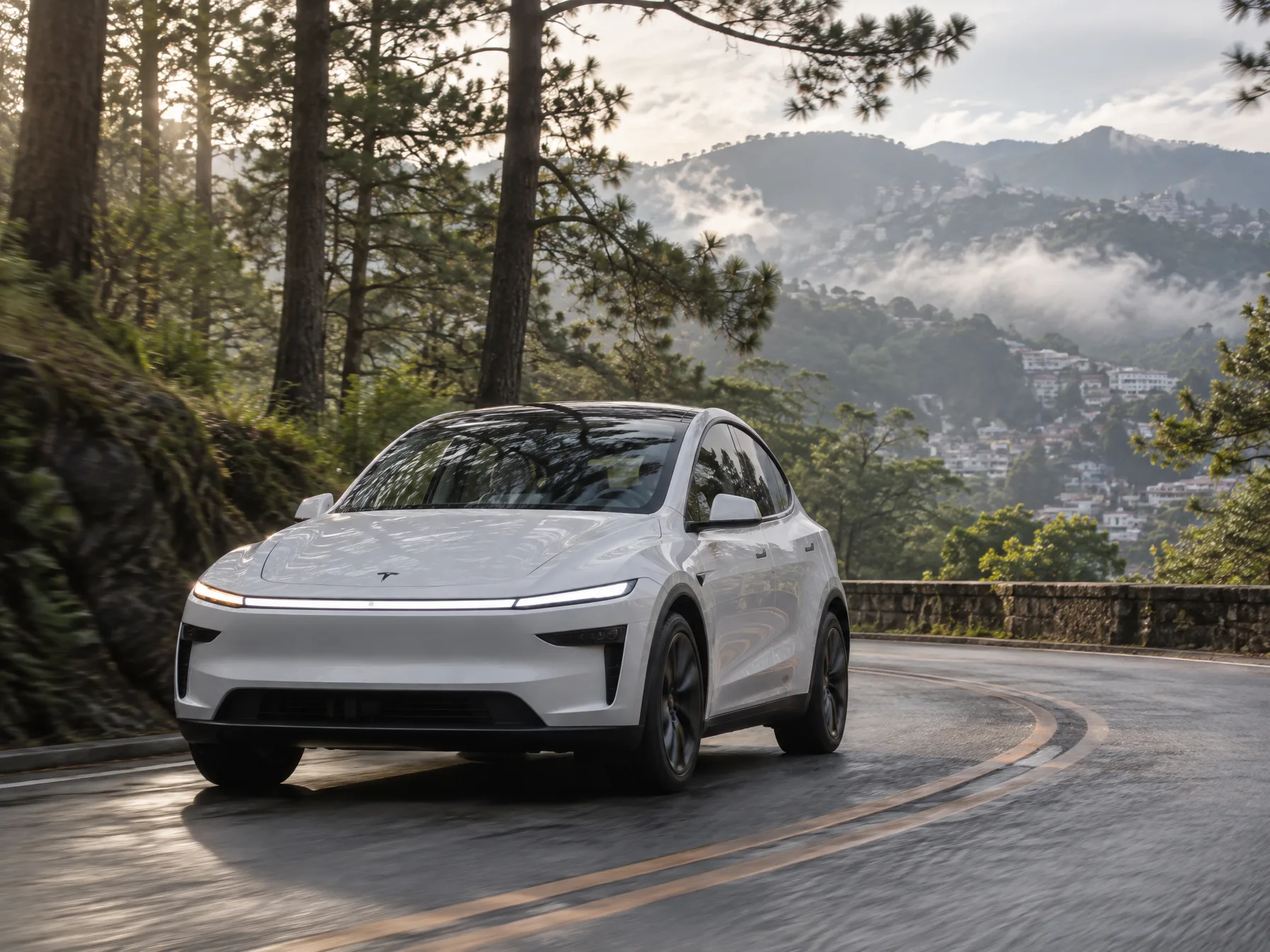
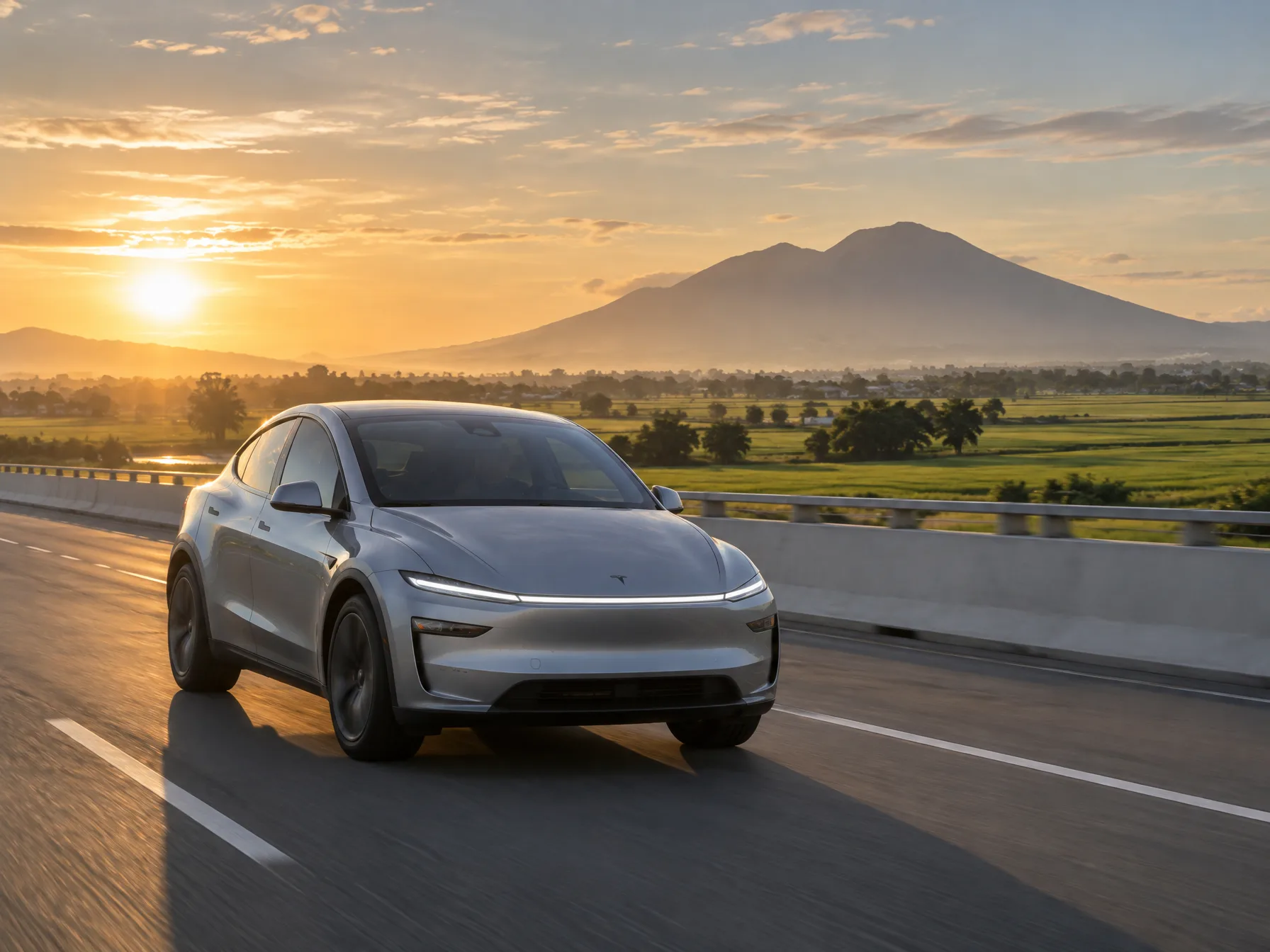
Typical Manila-origin targets in the north include Baguio (cool pine-covered city, Burnham Park and Camp John Hay), Clark and Angeles (airport, food, malls and theme parks), San Juan and San Fernando, La Union (the surf town of the north), Hundred Islands in Pangasinan, Subic Bay (beaches, wildlife and shopping), and Bataan (Mt. Samat Shrine and the heritage resort Las Casas Filipinas de Acuzar). The north has the best DC coverage along NLEX, SCTEX and TPLEX, and the upcoming Baguio Supercharger would be a milestone.
South Luzon destinations
| Destination | Province | One-way km | Drive time* | Main roads | kWh (Model Y L) | Cost at home | Cost at Supercharger | Gasoline SUV (10 km/L) |
|---|---|---|---|---|---|---|---|---|
| Antipolo Cathedral Shrine of Our Lady of Peace and Good Voyage, a pilgrimage site. | Rizal | 20 | 24 min | Ortigas Avenue, Ortigas Avenue Extension | 3 | ₱49 | ₱63 | ₱196 |
| Aguinaldo Shrine, Kawit Ancestral house where Philippine independence was proclaimed on June 12, 1898. | Cavite | 21 | 22 min | CAVITEX | 3 | ₱51 | ₱66 | ₱206 |
| Enchanted Kingdom, Santa Rosa Theme park in Santa Rosa, Laguna. | Laguna | 35 | 35 min | SLEX | 6 | ₱84 | ₱108 | ₱338 |
| Daranak Falls, Tanay Waterfall in Tanay, Rizal. | Rizal | 57 | 1 h 02 min | Sampaloc Road, Ortigas Avenue, Ortigas Avenue Extension | 9 | ₱136 | ₱175 | ₱545 |
| Tagaytay - Sky Ranch Amusement park on the Tagaytay ridge with a Ferris wheel and Taal views. | Cavite | 61 | 1 h 01 min | Aguinaldo Hwy, CAVITEX | 10 | ₱145 | ₱187 | ₱585 |
| Hidden Valley Springs Resort (OSM: Alaminos, Laguna) Nature resort with spring-fed pools. Listed under Alaminos, Laguna on OpenStreetMap. | Laguna | 72 | 1 h 07 min | SLEX, Maharlika Hwy (Pan-Phil) | 12 | ₱173 | ₱223 | ₱696 |
| Lipa City Hall Commercial city in Batangas; historically known for coffee. | Batangas | 74 | 1 h 04 min | SLEX, STAR Tollway | 12 | ₱175 | ₱226 | ₱706 |
| Pila, Laguna Town noted for its preserved Spanish-era plaza (heritage zone). | Laguna | 76 | 1 h 10 min | SLEX | 12 | ₱182 | ₱235 | ₱734 |
| Nasugbu (town center) Beach-resort coastline town in west Batangas. | Batangas | 89 | 1 h 30 min | CAVITEX | 14 | ₱213 | ₱274 | ₱857 |
| Taal Heritage Town Spanish-era town with ancestral houses and the Basilica of St. Martin de Tours. | Batangas | 97 | 1 h 33 min | Aguinaldo Hwy, CAVITEX | 16 | ₱231 | ₱297 | ₱929 |
| Pagsanjan Falls Waterfall reached by banca 'shooting the rapids' rides; the falls are in Cavinti, Laguna. | Laguna | 99 | 1 h 35 min | SLEX | 16 | ₱235 | ₱303 | ₱947 |
| Calaca, Batangas Coastal west-Batangas town. | Batangas | 99 | 1 h 34 min | Aguinaldo Hwy, CAVITEX | 16 | ₱237 | ₱305 | ₱952 |
| Batangas International Port Ferry gateway to Calapan (Oriental Mindoro) and Puerto Galera-bound routes. | Batangas | 101 | 1 h 25 min | SLEX, STAR Tollway | 16 | ₱240 | ₱310 | ₱967 |
| Anilao, Mabini Diving hub of Luzon, popular for macro-diving. | Batangas | 115 | 1 h 37 min | SLEX, STAR Tollway | 19 | ₱274 | ₱353 | ₱1,101 |
| Lucena City Capital city of Quezon province. | Quezon | 127 | 1 h 48 min | Maharlika Hwy (Pan-Phil), SLEX | 21 | ₱304 | ₱392 | ₱1,223 |
| Pagbilao, Quezon Coastal Quezon town. | Quezon | 134 | 1 h 53 min | Maharlika Hwy (Pan-Phil), SLEX | 22 | ₱320 | ₱413 | ₱1,289 |
| Mauban, Quezon (Cagbalete jump-off) Mauban is the usual mainland access to Cagbalete Island. | Quezon | 156 | 2 h 17 min | Maharlika Hwy (Pan-Phil), SLEX | 25 | ₱371 | ₱478 | ₱1,493 |
| Naga City Bicol regional center; Peñafrancia pilgrimage city. | Camarines Sur | 384 | 4 h 55 min | Maharlika Hwy (Pan-Phil), SLEX | 62 | ₱916 | ₱1,181 | ₱3,687 |
| Legazpi City (Albay) Gateway city to Mayon Volcano. | Albay | 477 | 6 h 24 min | Maharlika Hwy (Pan-Phil), SLEX | 77 | ₱1,138 | ₱1,466 | ₱4,578 |
*Drive time is the OpenStreetMap/OSRM routing estimate from Makati CBD at normal speeds, excluding charging stops, traffic and toll queues. Energy assumes the Model Y L's 681 km WLTP rating at an 80% real-world factor (about 16.2 kWh/100 km); home charging uses Meralco's Sep 2026 rate of ₱14.74/kWh, Supercharger ₱19/kWh, gasoline RON 95 at ₱96.03/L and 10 km/L. All distances are one way by road.
South of Manila the classics are Tagaytay (Taal Volcano views, bulalo, cool air), Nuvali and Santa Rosa (Enchanted Kingdom, outdoor parks), Lipa and Batangas (kapeng barako, Taal Heritage Town, Anilao diving, Nasugbu beaches), Pagsanjan Falls in Laguna, Lucena and Quezon, Antipolo (pilgrimage, hilltop dining) and, for the ambitious, Bicol (Mayon Volcano from Legazpi, Naga City), which is a long drive that needs deliberate charging stops. In the south, Tesla has a destination charger at Southwoods Mall in Biñan, and there are DC options on SLEX at Calamba, Biñan and Santa Rosa.
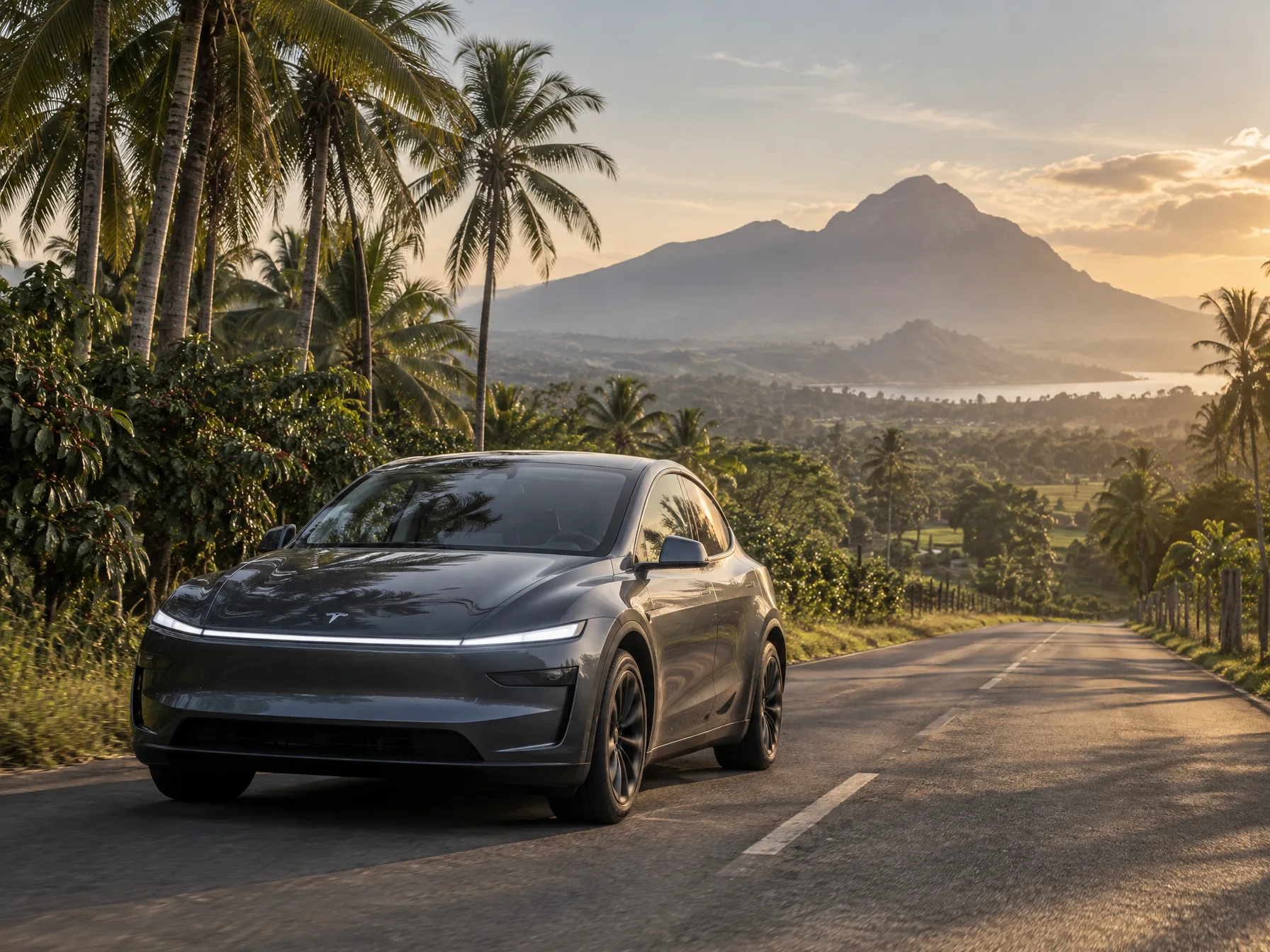
Road-trip tips that save time and stress
- Charge before you leave. Top up at home to 90-100% the night before, or on trip day at an 11 kW destination charger. Starting full is free range.
- Pre-condition in the app. Cool the cabin in the Tesla app while still plugged in, so the air-con is not stealing range on the first km.
- Plan stops with the navigation. In-car navigation can route via Superchargers and pre-warm the battery. For non-Tesla DC stations, cross-check the operator app before relying on them.
- Keep two backup chargers on your list. If a DC unit is out of service or a queue forms, you want the next option within range. A 22 kW AC at a hotel is a fine fallback if you are staying overnight.
- Get your charging apps and cards ready. Install AC Mobility, Shell Recharge, Petron Power Up and other operator apps, and load payment before you go. Also prepare your Autosweep and Easytrip RFID stickers, and check balances before you hit the toll plaza.
- Drive smoothly. Highway speeds above 100 km/h cost range. Staying around 90-100 km/h typically buys noticeably more range in any EV.
- Arrive with 10-20%. Fast chargers are quickest at low state of charge. Stop at 70-80% and move on.
Savings & the bigger economic picture
For a household, the pitch is simple: electricity per kilometre is a fraction of gasoline per kilometre. For the country, the picture is more nuanced: EVs are a promising lever, but today they are still too few to move national statistics. Start with your own wallet, then zoom out.
What a kilometre costs
| Energy source | Assumption | ₱ per 100 km | ₱ per km |
|---|---|---|---|
| Tesla Model Y L, home charging | Meralco about ₱14.74/kWh, 88.2 kWh / 681 km rated plus 10% charging loss | about ₱210 | about ₱2.10 |
| Tesla Model Y L, home charging (conservative real-world) | 16.2 kWh/100 km (80% factor) | about ₱239 | about ₱2.39 |
| Tesla Model Y Long Range, home charging | research estimate | about ₱238 | about ₱2.38 |
| Tesla at Supercharger | ₱19/kWh, 16.2 kWh/100 km | about ₱308 | about ₱3.08 |
| Gasoline crossover, RON 91 | ₱89.13/L at 12 km/L | about ₱743 | about ₱7.43 |
| Gasoline crossover, RON 95 | ₱96.03/L at 12 km/L | about ₱800 | about ₱8.00 |
| Gasoline crossover, RON 95, heavier use | ₱96.03/L at 10 km/L | about ₱960 | about ₱9.60 |
Fuel prices are Metro Manila pump prices effective 6 October 2026. The Meralco rate is the September 2026 overall residential rate (₱14.7424/kWh); October's rate was not yet announced at time of writing, and the effective rate for some customers is affected by refunds. The 10-12 km/L gasoline range is our assumption.
In round numbers, charging at home is about three-quarters cheaper per km than gasoline. At 15,000 km a year, that is roughly ₱38,000 of electricity versus ₱111,000-134,000 of gasoline, a saving of about ₱74,000-97,000 a year or ₱6,000-8,000 a month. Be realistic about the sticker price, though: against a ₱1.2 million gasoline crossover, a ₱2.8 million Tesla carries a price gap of ₱1.2-1.6 million, so fuel savings alone take over a decade to repay it. People buy the Model Y L for the whole package, which includes the performance, software, safety and 6-seat space, and the lower running cost is a major bonus, not the whole business case.
Also worth knowing: a driver doing 1,000 km a month would add roughly ₱2,100-2,400 to a Meralco bill, which is our own estimate, not an official figure.
The economy-wide view
- Oil dependence. The Philippines' net oil import bill in 2024 was about US$11.15 billion out of roughly US$11.73 billion of reported imports in the DOE's initial data. The country imports nearly all its oil, and about 98% of it has come from the Middle East. In 2026 that exposure hurt: a war-driven supply shock led the government to declare a national energy emergency on 24 March 2026 (it ended 30 June 2026), and April's trade deficit hit about US$5.97 billion, a four-year high, driven by mineral fuels.
- Trade balance and the peso. Every litre of gasoline not burned is a dollar not spent. An EV still draws on the power grid, which uses a mix of domestic and imported fuels, so the benefit is real but partial and depends on the grid mix.
- Adoption is still small. EV sales reached 38,286 units in January-July 2026, about 15.8% share, but most of those were hybrids, and battery-electric sales in the first half of 2026 were reported down year on year by one source. A 2026 UP Diliman student thesis found no statistically significant effect of EVs on national gasoline demand yet. In other words, the national payoff is a long-term story.
- Air quality and emissions. Transport accounts for roughly a third of the Philippines' greenhouse gas emissions in the figures cited (31.6% in 2017). Local air quality in cities benefits from zero tailpipe emissions. The climate benefit depends on how clean the grid becomes; the DOE has set a target for renewable energy to supply 25% of EV charging by 2030 and 100% by 2040.
- Nickel opportunity. The Philippines has some of the world's richest nickel reserves, and a large share of China's nickel ore imports has come from here. The prize is turning raw ore into battery materials at home. A government EV Incentive Strategy signed in July 2026 offers up to ₱60 billion of fiscal support to local EV manufacturing, and a planned battery-storage factory at New Clark City is cited at 2,500 jobs. Whether that translates into domestic EV production is still to be seen.
- Grid demand. An older DOE projection estimated that about 52,000 battery EVs and 170,000 plug-in hybrids by 2030 would add around 245 MW to the evening peak, about 5.3% of projected reserves. Real adoption is on a different curve, and the DOE has told utilities to plan upgrades. The grid had stress events in 2026, which is a good reason to charge off-peak.
What it means for you: the personal savings are real and quick, the national benefits are real but gradual, and the government's incentives (0% import tariff through 2028, exempt excise tax, number-coding exemption) can change. Buy for the car you like and treat the savings as a rewarding side effect.
Install a Tesla charger at home: requirements and step-by-step
Ninety percent of EV charging happens at home, so this is the most important section of your ownership. A home charger turns your parking slot into a private gas station that costs a few pesos per kilometre and is always full by morning.
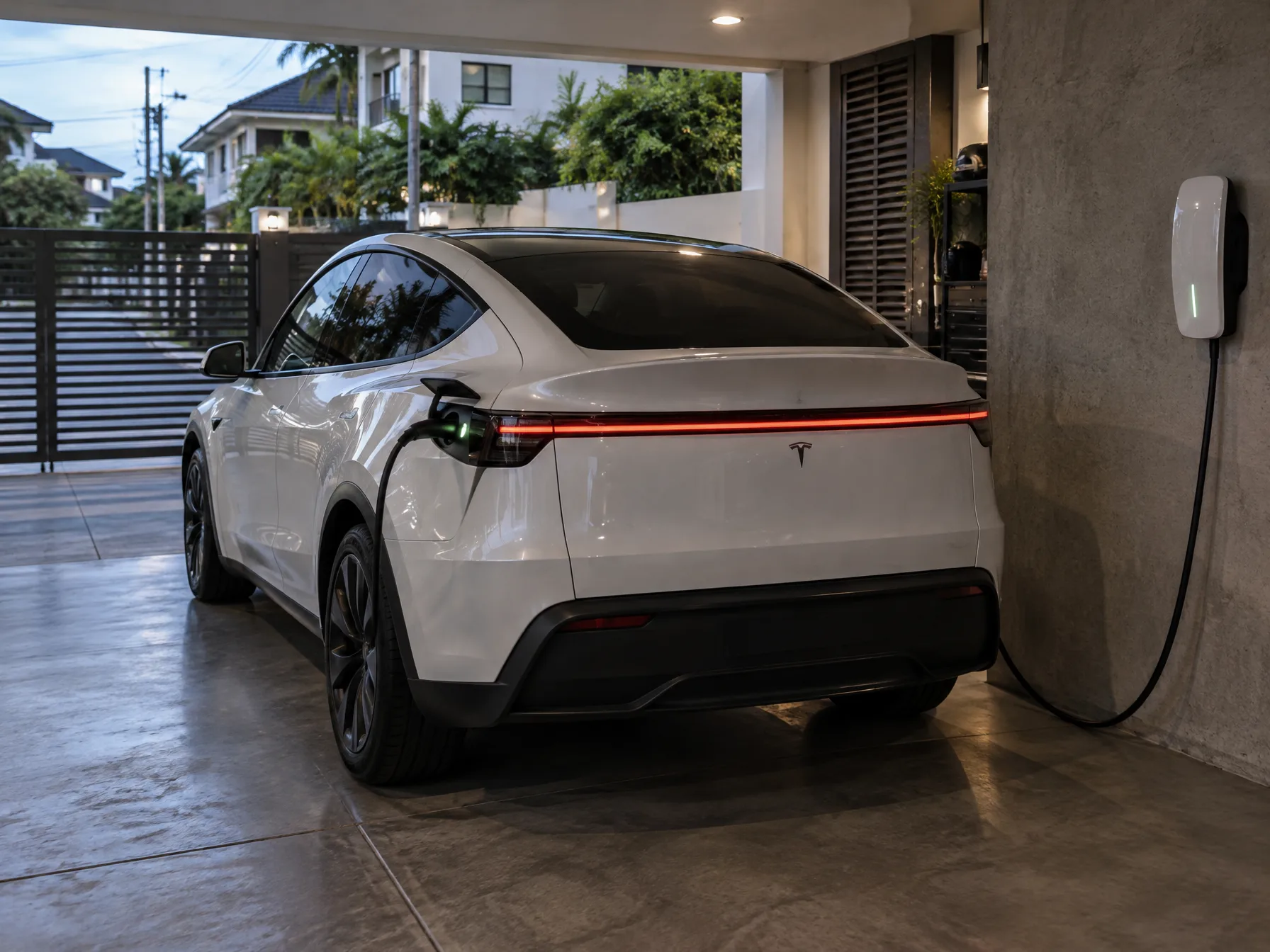
Wall Connector or Mobile Connector?
- Wall Connector: permanently mounted, up to about 11.5 kW (48 A) in Tesla's generic specs, neat, and it is the thing Tesla Philippines has reportedly been giving new buyers at no charge. Needs a dedicated circuit.
- Mobile Connector: portable, plugs into a suitable outlet, slower unless the outlet is a heavy-duty one. Useful as a backup or when renting. A kit is reported at about ₱34,800 from a third-party retailer.
The free Wall Connector for new buyers has been reported by Tesla Philippines and media, and promos can change, so confirm in your order.
Step by step
- Know your parking situation. House with a garage: easy. Condo: you will need written approval from the property administrator or board, and a parking slot with accessible power. Owned slot or a rented slot makes a difference. Ask early, since this is the most common delay.
- Choose the charger. For most owners the 11 kW Wall Connector is ideal. If your home is single-phase, which is common, check the maximum current your installation can supply. That can set the actual charging speed.
- Get your main panel checked. A licensed electrician (ideally a Registered Electrical Engineer, REE) should review your service size, main breaker, spare capacity and grounding. A Wall Connector at full power draws a continuous load of tens of amperes, comparable to a large air-conditioner or two.
- Design a dedicated circuit. The charger gets its own breaker, correctly sized wire, and a ground fault protection (GFCI/RCD) as your electrician specifies. Charging is a long continuous load, so the circuit is typically sized with margin. Do not share it with other appliances.
- Follow the Philippine Electrical Code (PEC) 2017. Your electrician should design and install to PEC 2017 and local requirements, and issue the required electrical plans and permits. Ask for the electrical permit and certificate of completion, which are useful for insurance and resale.
- Coordinate with Meralco if needed. If your current service is too small for the extra load, you may need a service upgrade, which involves your utility. In Meralco territory, ask about their EV charging guidance, and about time-of-use options if offered, before you commit.
- Mount and wire. Mount near the charge port side of your parking spot so the cable reaches without strain. Use weather-rated conduit outdoors. In Philippine monsoon conditions, protect against water ingress and keep it off the floor to avoid flooding risk.
- Commission in the Tesla app. Connect the Wall Connector to Wi-Fi, add it to your Tesla account, and set the charge current limit to match your circuit. Tesla may also provide installation support for new buyers; ask your delivery advisor.
- Do a test charge. Charge for at least an hour and check that the breaker stays cool and the connections show no heating. Your electrician can do a thermal check.
- Schedule it. In the car or app, set a scheduled charge window for off-peak hours, and a daily charge limit of 80% to 90% for daily use. Save 100% for road trips.
Common mistakes
- Using a cheap extension cord or a shared outlet. Never do this with an EV; charging is a continuous heavy load.
- Skipping the panel check, then tripping the main breaker when the air-con and charger run together.
- Forgetting condo approvals, then being told to remove the charger.
- Installing the charger too far from the charge port, so the cable does not reach in all parking angles.
- Expecting full speed from a single-phase supply that cannot deliver it. Set the charge current in the app to match what the circuit can safely carry.
- No weather protection for outdoor installations during typhoon season.
Safety disclaimer: this is general guidance, not an electrical design. Always hire a licensed professional electrician or REE for installation, follow PEC 2017 and local rules, and follow Tesla's own instructions for your charger. Never modify the charger or bypass protections.
Use the planner below to estimate the cost, time and circuit size for your situation.
Tesla app for beginners
The Tesla app is your key, remote control, trip planner and energy dashboard in one. Before delivery, try the interactive walkthrough below, then follow our written beginner guide.
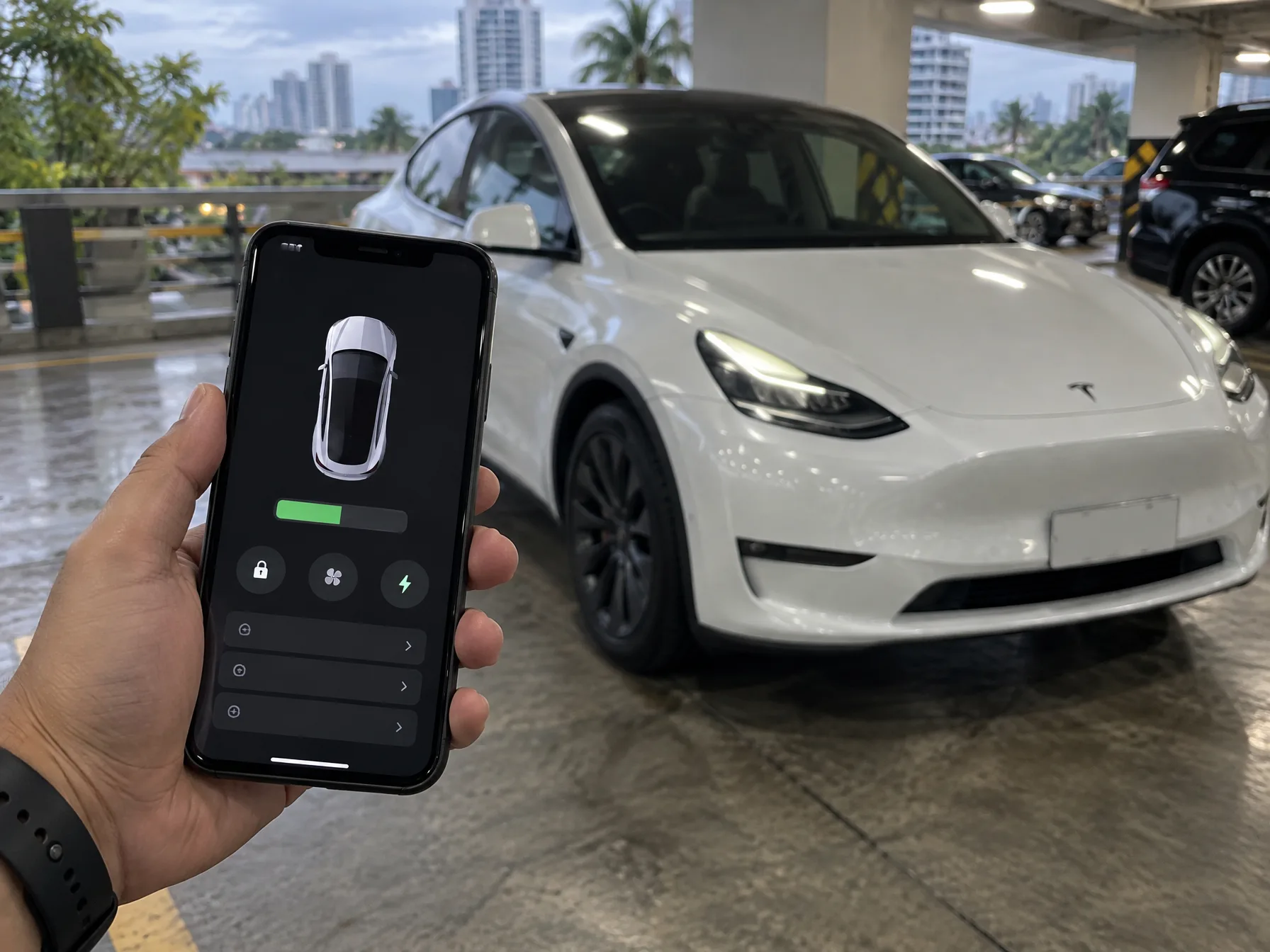
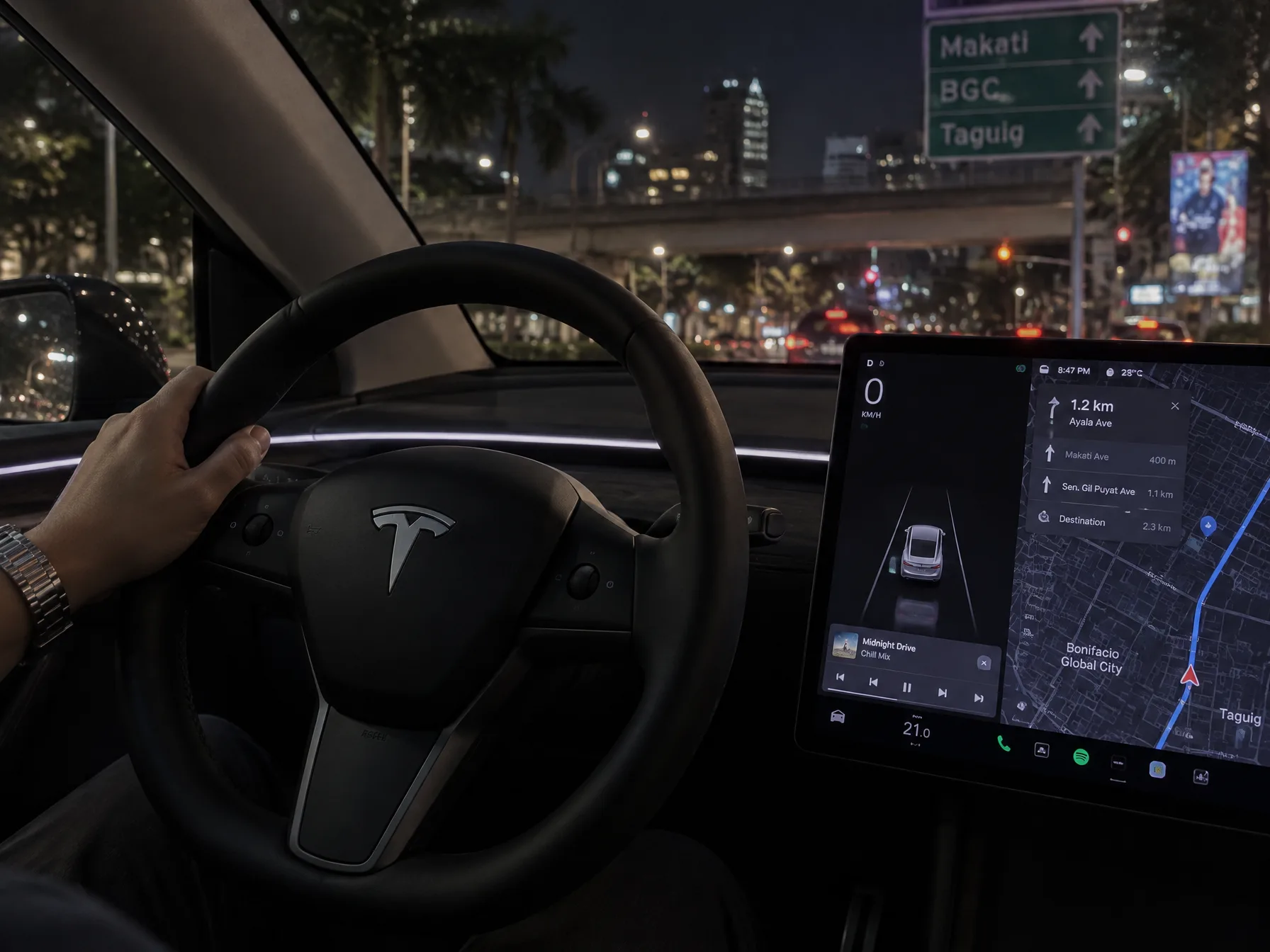
Your first day with the app
- Create your account. Use the same email you used for your order. The vehicle appears in the app after delivery is confirmed.
- Set your phone as the key. The phone key uses Bluetooth, so the car unlocks as you walk up and locks as you walk away. Keep the key card in your wallet as a backup, as the phone battery can die.
- Climate and pre-conditioning. Start the air-con from your phone five minutes before you leave. In Philippine heat that single habit makes the cabin liveable and, if you are plugged in, costs you no range.
- Charging. See the charge level, set a charge limit, schedule departure and view charging history. This is where you will set your off-peak window.
- Sentry and Valet modes. Sentry uses the cameras to watch the car when parked and can save clips; Valet limits speed and locks the glovebox when someone else drives. Remember that Sentry draws a little power and requires a USB drive for clips.
- Software updates. Cars receive over-the-air updates. Connect to home Wi-Fi so large updates download without using data, and schedule installs when you do not need the car.
- Share access. Add family members as drivers, with their own phone keys and driver profile, under the app's access or security settings.
Beginner tips
- Check where the car is, and track it if it is ever moved, using the vehicle location feature.
- Use "scheduled departure" so the car charges to finish just before you leave and the cabin is pre-cooled.
- Smart Summon and similar features need Enhanced Autopilot or FSD and may not be available in the Philippines; check your car's feature list.
- Keep the app updated, and turn on notifications for charging complete and charging interrupted.
- Learn the "Premium Connectivity" difference: some live features (satellite maps, live traffic, streaming, and Grok) require it or Wi-Fi.
Tesla's AI advantage: Grok, FSD and the computer brain
Tesla spends more time talking about AI than about cars, and as a buyer you should know which parts you actually get in the Philippines today and which are the company's roadmap. We will separate the two clearly.
Verified in the Philippines today
- Available Grok in the car. Not a Tesla App reported in June and July 2026 that Grok is rolling out in the Philippines with software 2026.20 or later, alongside several other Asian markets. It needs compatible hardware (reports say cars with the newer AMD Ryzen infotainment computer) and a Premium Connectivity subscription or Wi-Fi. Grok is labelled beta. Whether your specific car qualifies depends on its build, so ask your delivery advisor.
- Available Basic Autopilot is standard (traffic-aware cruise control and lane keeping). Enhanced Autopilot is a ₱197,000 option on the Model Y L.
- Available Over-the-air updates arrive regularly and add features after delivery.
- Not active FSD (Supervised). Tesla Philippines sold "FSD Capability" for ₱394,000 as a one-time purchase until 30 June 2026, after which it moved to a subscription model, but media reported it as not available for use in the Philippines. We found no evidence it is activated here as of October 2026. If you are buying for FSD you are betting on the future, not buying a feature that works today.
Tesla's global roadmap (claims, not Philippine features)
- Hardware generations. Recent Teslas carry "AI4" (also called HW4) computers. Tesla and Elon Musk have said a next chip, "AI5", will start in small volume in late 2026 with volume production in 2027, built at TSMC and Samsung, with claims of up to 40 times the compute of HW4. These are the company's own claims and have yet to be independently verified.
- Training compute. Tesla shut down its in-house Dojo supercomputer project in August 2025 (reported by TechCrunch), shifting toward other training hardware. It is a reminder that AI roadmaps shift.
- Software that improves. Over-the-air updates are why many owners get excited. A car delivered today can gain features, such as Grok integration and its slated vehicle-control commands, without a trip to the service centre.
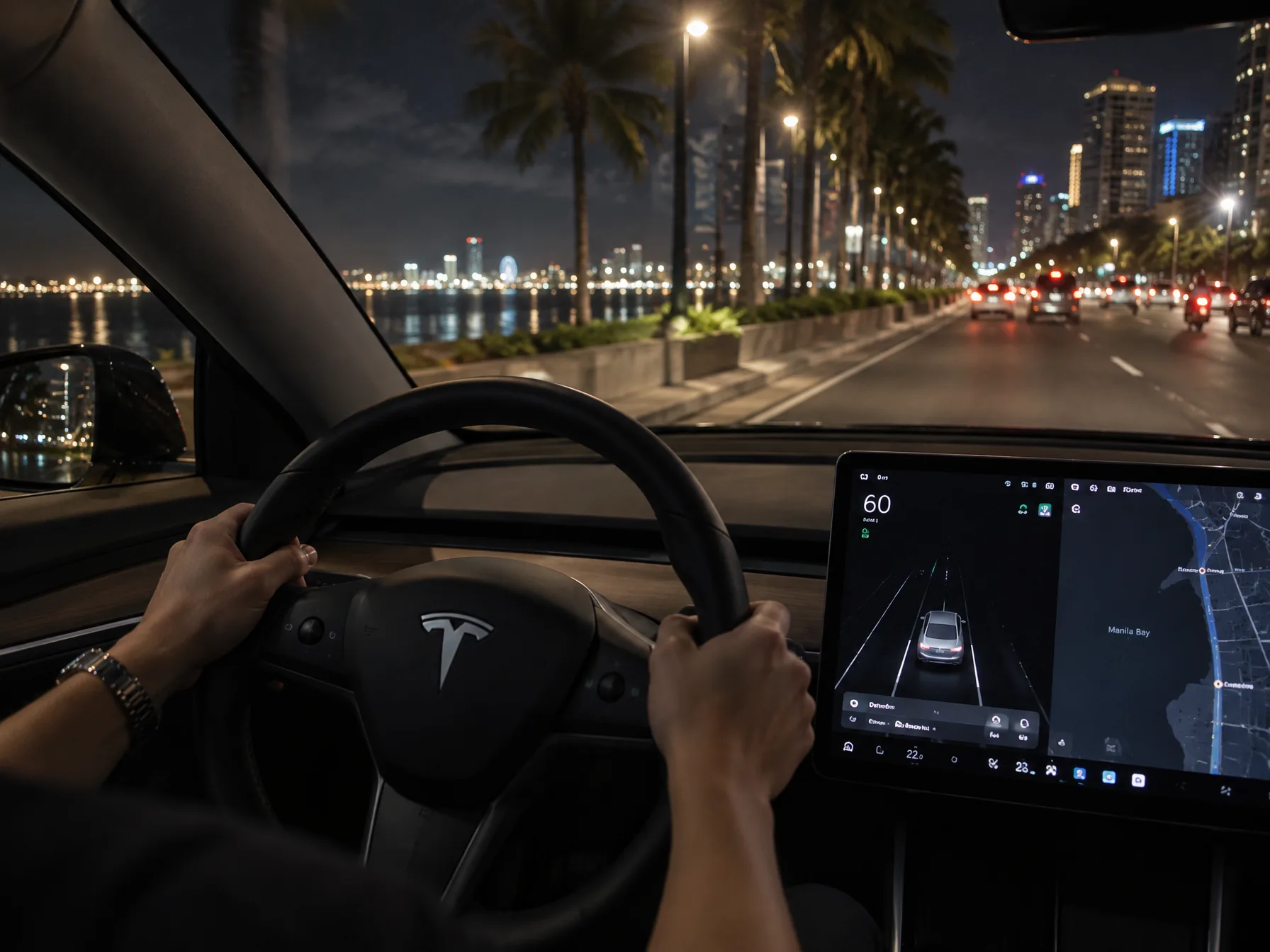
What this means for a Philippine buyer: buy the Model Y L for what it does today, which is range, charging, efficiency, space and a polished screen-first interface. Treat FSD as an uncertain future bonus, and do not pay extra for it unless the price is acceptable even if it never arrives here. Grok is a nice extra, not a reason to buy.
How about BYD? BYD offers its own driver-assist suite on its models, and the specifics depend on model and trim. We have not compared its performance in the Philippines with Tesla's, and we would not claim a winner. What is fair to say is that Tesla's strength is the integrated software ecosystem and update frequency, while BYD's strength is breadth of models and prices, as we covered in the head-to-head.
Frequently asked questions
Can a Tesla drive through floods in the Philippines?
It is not advised. The battery sits under the floor, and manufacturers generally advise against driving through standing water and say not to restart a flooded EV. Wading depth differs by model, so check the owner's manual and avoid deep water.
Does insurance cover flood damage to an EV?
Most comprehensive policies cover flood as an "act of nature", but check the exact wording. The battery can be a large share of the car's value, so confirm that the battery is covered. Tesla Philippines has also been reported to include one year of comprehensive insurance with Model Y purchases, so check what your order includes.
How much does EV insurance cost?
Reported figures range from about ₱7,000 to ₱34,000 a year depending on car value, and some insurers charge more than for a gasoline car. Get quotes from several insurers, since pricing for EVs is still being worked out.
How long does a Tesla battery last, and what is the warranty?
Tesla's reported battery and drive unit warranty in the Philippines is 8 years or 192,000 km, with a 4-year or 80,000 km basic warranty. Batteries do degrade slowly with age and use, but most owners see modest loss over years. Confirm the exact terms on your order documents.
What is the resale value of a Tesla in the Philippines?
There is not yet much Philippine used-EV data. Globally, EVs have tended to lose value faster than gasoline cars in the first few years, although Tesla's brand and software support help. Treat any resale promise with caution, and note that VinFast has published a residual-value guarantee, which Tesla and BYD have not (that we found).
What does home charging cost?
At Meralco's September 2026 overall rate of about ₱14.74/kWh, a full 88.2 kWh charge on the Model Y L costs about ₱1,300 from empty, and a typical week of commuting costs a few hundred pesos. Installation cost is separate; see the home charger section.
How much will my Meralco bill go up?
Our own estimate is about ₱2,100-2,400 a month for 1,000 km of driving. It varies with your driving style and rate. This is not an official figure, so use the savings calculator with your numbers.
How much does the Supercharger cost?
Tesla Superchargers in the Philippines are reported at about ₱19/kWh, and destination chargers at about ₱16/kWh. That compares with about ₱22-28.50 (AC) and ₱35 (DC) per kWh at some third-party networks. Prices can change, so check the Tesla app before you plug in.
Are there Superchargers outside Metro Manila?
Not yet. All four current Supercharger sites are in Metro Manila. A Baguio site is listed as coming, and others in Cebu and Clark have been mentioned, but no dates have been announced. Outside Metro Manila, use destination and third-party chargers.
Can I take a Tesla on a long trip, like Manila to Baguio?
Yes. The Model Y L has a 681 km WLTP rating, which is about 545 km at an 80% real-world factor, and there are DC chargers along NLEX, SCTEX and TPLEX. Plan your stops in advance, start with a full charge and keep a backup charger in mind.
Can non-Tesla EVs like BYD use Tesla Superchargers here?
We found no evidence that Tesla has opened its Philippine Superchargers to other brands. Assume Tesla-only for now. A Tesla, on the other hand, can use CCS2 chargers from other networks.
Are CHAdeMO or GB/T chargers compatible?
No. A Philippine-spec Tesla uses CCS2 for DC and Type 2 for AC. If a station only lists CHAdeMO or GB/T, it will not work for you. No NACS adapter is needed in the Philippines.
How are registration fees and taxes treated for EVs?
Under the EV Industry Development Act (RA 11697), battery EVs receive a 30% discount on motor vehicle user's charge, registration and inspection fees, plus priority registration and a special plate. Battery EVs are also excise-tax exempt under the TRAIN law, and 0% import duty applies through 2028. VAT of 12% still applies as far as we found. Confirm with the LTO and your dealer.
Are EVs exempt from number coding?
Yes. The DOE has clarified that battery EVs, hybrids and plug-in hybrids are automatically exempt under the EV law, with no separate DOE certification needed. There was enforcement confusion in October 2025, so keep your registration and plate in order.
Do Tesla tires wear faster?
Often yes, because EVs are heavier and deliver torque instantly. Rotate tires on schedule and check pressures regularly. Specific wear data for the Philippines is limited.
Where can I get a Tesla serviced?
Tesla's Philippine service and delivery are centred on the Tesla Center at Uptown Parade in BGC, and we did not verify any mobile-service coverage. Service coverage outside Metro Manila is limited, which matters if you live in the provinces. Ask Tesla about the nearest option.
Can Tesla vehicles use number coding exemption "green plates"?
EVs are eligible for a special green plate under the EV law. In practice, check with the LTO on how and when your plate is issued.
Is FSD available in the Philippines?
Not as of October 2026 in any form we could verify. Tesla Philippines sold FSD Capability as a ₱394,000 purchase until 30 June 2026, but media reported it as not available for use in the country. Do not buy it expecting it to work next month.
Does Grok work in Philippine Teslas?
Grok has been reported rolling out in the Philippines with software 2026.20 or later, on compatible hardware, via Premium Connectivity or Wi-Fi. It is in beta, and not every car is eligible. Ask your delivery advisor about your specific car.
What financing is available?
Tesla has promoted bank-financing options. One example reported for the Model Y L was a down payment of about ₱569,800 and about ₱48,876 a month over 60 months. Rates and terms vary by bank and applicant, so get several quotes.
Is the deposit refundable?
Reports in April 2026 said the Model Y L reservation deposit of ₱15,000 is non-refundable. Confirm the current terms on Tesla's Philippine site before you pay.
How long is delivery?
Tesla Philippines indicated two to three months for Model Y L orders at launch in April 2026, and a May 2026 report said deliveries began within about a month of orders opening. Timing changes with stock and colour, so ask your advisor.
Model Y L or standard Model Y: which should I get?
The Model Y L is a six-seat, longer car with a bigger 88.2 kWh battery and 681 km WLTP range, at an indicative ₱2,849,000. The standard Model Y is a five-seater starting at ₱2,369,000. Choose the L if you have a larger family or do long trips, and the standard Model Y if you want the lowest entry price.
Is the Model Y L the best-selling EV in the Philippines?
No. BYD leads battery-electric sales, with VinFast second and Tesla third for January-August 2026, while Tesla was the top EV brand in 2025 and for single months such as June 2026. We recommend the Model Y L on its merits, not on a sales ranking.
How do I charge in a condo?
Ask your condo administration about permission, the location of your parking slot, and whether power can be routed to it. Some buildings have shared chargers. Under the EV law, new buildings with 20 or more parking slots must reserve 5% of them for EV charging, though the implementing rules are still being drafted.
Are battery EVs really cheaper to run than hybrids?
Per kilometre, yes. A hybrid improves gasoline use, but an EV on home electricity is about a quarter to a third of the cost per km. The EV's purchase price is higher, so the question is how many kilometres you drive.
Will the government incentives last?
Not forever. The 0% import tariff runs through 2028, and the EV law's registration discounts and non-fiscal perks run for eight years from effectivity (around 2030). The government was reported in September 2026 to be weighing an extension, but there is no decision yet.
The verdict: why the Model Y L is our flagship pick
If we had to pick one EV for a Filipino family in 2026, it would be the Tesla Model Y L. It has six seats, a rated 681 km of range, a 250 kW Supercharger network that is small but growing, a software experience that keeps improving, and running costs of around ₱2 per kilometre at home. Those are real strengths, and the 8-year/192,000 km battery warranty is reassuring.
It is not for everyone. If your budget is closer to ₱1-1.7 million, BYD is the better value, with a wider range of models, more dealers, and a wider choice of plug-in hybrids if you worry about range. And if you live far from Metro Manila and drive long distances often, check the charging map around your route before you commit.
Next step: run your own numbers in the savings calculator, check your parking and electrical situation, and confirm current prices and promos at tesla.com/en_ph.
Do you agree — is Tesla the best EV choice in the Philippines?
Cast your vote and see how other readers feel.
Sources & disclaimer
- Autocar Philippines, Opus Mall Supercharger: https://autocar.com.ph/tesla-adds-opus-mall-to-growing-supercharger-network-in-philippines/
- Autocar Philippines, new chargers in Laguna and BGC: https://autocar.com.ph/tesla-adds-new-ev-charging-stations-in-laguna-and-bgc/
- Top Gear Philippines, SM City Clark charger and planned sites (6 Oct 2026): https://www.topgear.com.ph/news/industry-news/tesla-charger-sm-city-clark-a6888-20261006
- Top Gear Philippines, BGC and Laguna chargers (27 Jul 2026): https://www.topgear.com.ph/news/motoring-news/tesla-philippines-new-charging-stations-bgc-laguna-a6938-20260727
- Top Gear Philippines, charging cost comparison: https://www.topgear.com.ph/features/tip-sheet/ev-charging-station-ph-cost-comparison-a6888-20260422
- Top Gear Philippines, Model Y L launch: https://www.topgear.com.ph/news/car-news/tesla-model-y-l-2026-ph-launch-a6941-20260326
- CarGuide.ph, SM Supermalls EV chargers: https://www.carguide.ph/2026/03/there-are-now-over-160-ev-charging.html
- CarGuide.ph, Model Y L arrival: https://www.carguide.ph/2026/03/2026-tesla-model-y-l-arrives-in.html
- CarGuide.ph, Model Y L delivery and pricing: https://www.carguide.ph/2026/04/itll-take-2-3-months-to-deliver-your.html
- Visor.ph, destination chargers: https://visor.ph/industry/tesla-ph-is-adding-more-ev-chargers-in-metro-manila/
- Gadgets Magazine PH, Model Y L: https://gadgetsmagazine.com.ph/mobility/cars/tesla-model-y-l-philippines
- Zigwheels PH, Tesla charging stations and Model Y L: https://www.zigwheels.ph/car-news/ph-retailed-tesla-vehicles-can-be-juiced-up-in-these-4-new-charging-stations
- expressway.ph EV charging directory and study: https://www.expressway.ph/ev-charging and https://www.expressway.ph/studies/how-many-ev-charging-stations-philippines
- The Auto PH, FSD purchase deadline: https://theautoph.com/tesla-owners-in-ph-can-only-buy-the-full-self-driving-feature-until-june-30/
- Zigwheels PH, Grok in Tesla PH: https://www.zigwheels.ph/car-news/tesla-ph-set-to-integrate-grok-ai-with-ev-lineup
- Not a Tesla App, Grok rollout and AI5 reports: https://www.notateslaapp.com/
- TechCrunch, Dojo shutdown: https://techcrunch.com/2025/08/07/tesla-shuts-down-dojo-the-ai-training-supercomputer-that-musk-said-would-be-key-to-full-self-driving
- Tesla owner's manual (phone key, climate, Sentry): https://www.tesla.com/ownersmanual/model3/en_sg/GUID-F6E2CD5E-F226-4167-AC48-BD021D1FFDAB.html
- RA 11697 (EVIDA): https://lawphil.net/statutes/repacts/ra2022/ra_11697_2022.html
- EO 12 and EO 62 (EV tariffs): https://lawphil.net/executive/execord/eo2023/eo_12_2023.html and https://lawphil.net/executive/execord/eo2024/eo_62_2024.html
- Power Philippines, DOE clarification on number coding: https://powerphilippines.com/doe-clarifies-evs-automatically-exempt-from-number-coding-under-evida-law/
- Department of Finance, EV Incentive Strategy: https://www.dof.gov.ph/dof-welcomes-eo-that-will-boost-local-ev-manufacturing/
- Context.ph, tariff extension under review (14 Sep 2026): https://context.ph/2026/09/14/govt-weighs-ev-tariff-extension-calibrated-incentives/
- Context.ph, Meralco September 2026 rates: https://context.ph/2026/09/11/meralco-cuts-september-power-rates-as-costs-shift/
- Tribune, pump prices (5 Oct 2026): https://tribune.net.ph/2026/10/05/gasoline-climbs-as-diesel-gets-relief
- Top Gear Philippines, CAMPI sales H1 2026: https://www.topgear.com.ph/news/industry-news/philippine-car-sales-h1-2026-a6941-20260723
- Zigwheels PH, Jan-Aug 2026 sales: https://www.zigwheels.ph/car-news/ph-auto-industry-ytd-sales-surpasses-300k-unit-mark-in-aug
- TFA, EV sales and incentives push (7 Sep 2026): https://tfa.ph/property_news/electric-vehicle-industry-pushes-extension-of-incentives-to-2040/
- UP Diliman thesis on EV adoption and gasoline demand: https://selib.upd.edu.ph/etdir/items/a3a3f51a-ad22-4796-abcf-57ebcd828816/full
- PIDS Discussion Paper 2021-15: https://pidswebs.pids.gov.ph/CDN/PUBLICATIONS/pidsdps2115.pdf
Disclaimer: this is independent editorial content from ManilaOpenHouse.com and is not affiliated with, endorsed by or sponsored by Tesla or BYD. Prices are indicative as of 8 October 2026 and can change without notice. Charger locations, power ratings, rates and availability change frequently. Illustrations are AI-generated and are not official Tesla photographs. Electrical, insurance, tax and legal information is general, not professional advice. Always verify current specifications, prices and promotions at tesla.com/en_ph and with your licensed electrician before you buy or install anything.
Photos
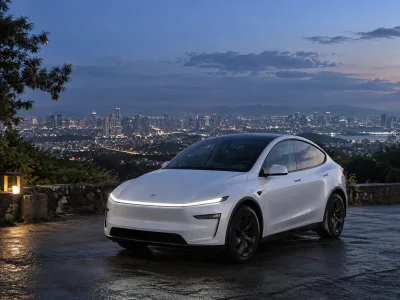
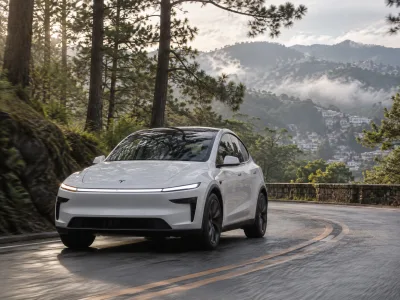
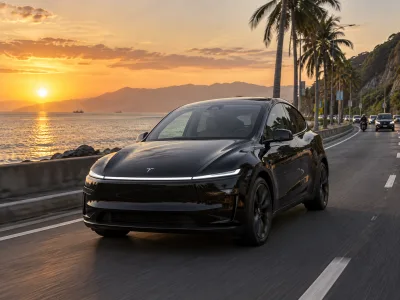
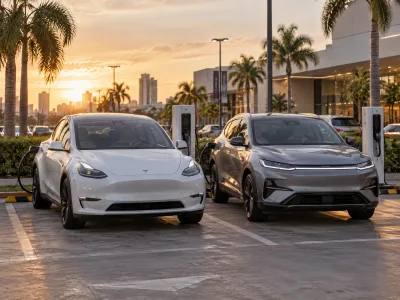
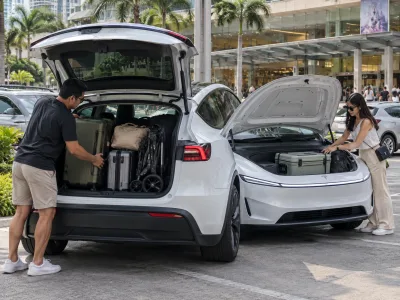
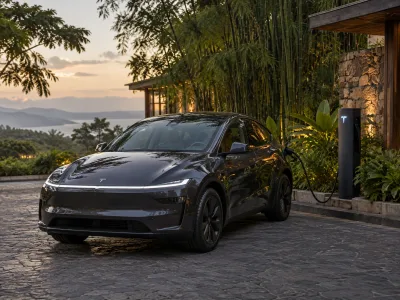
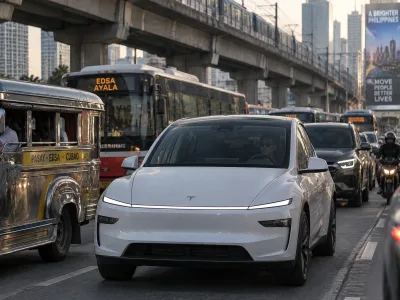
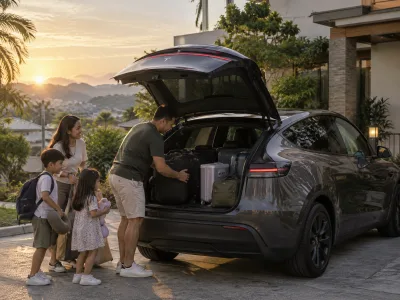
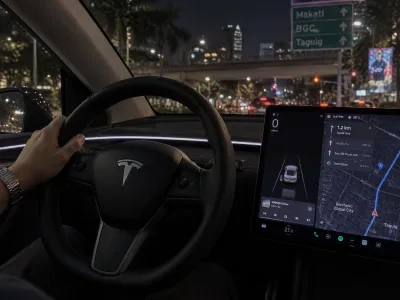
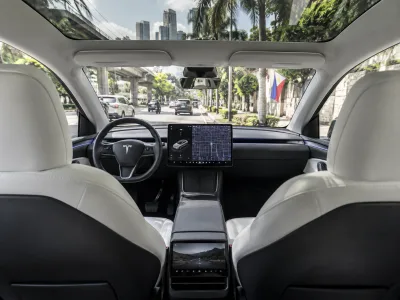

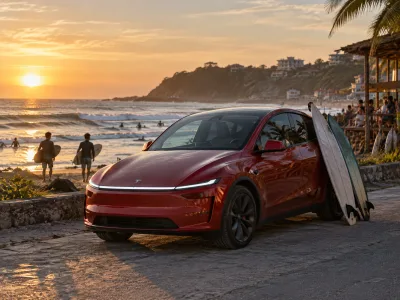
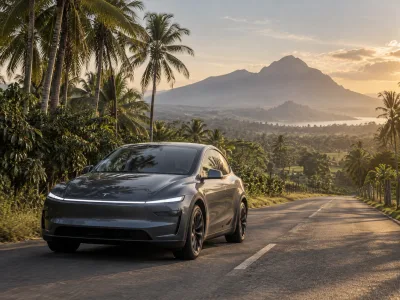
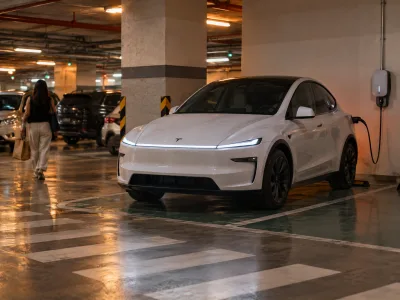
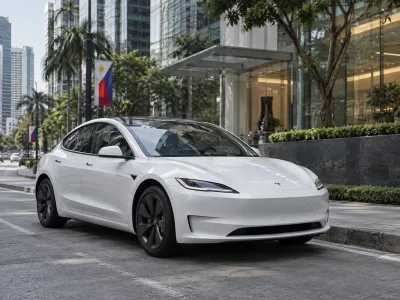
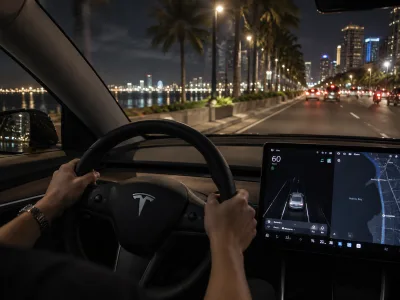
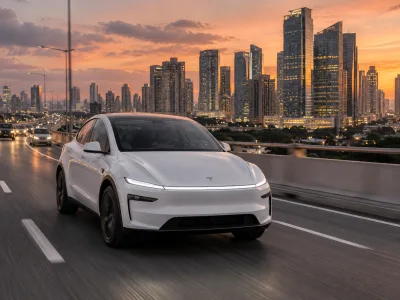
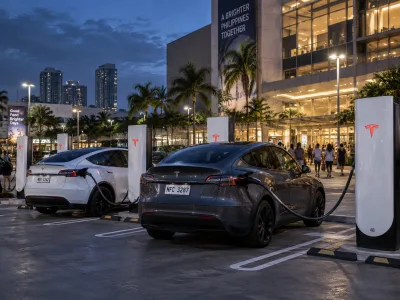
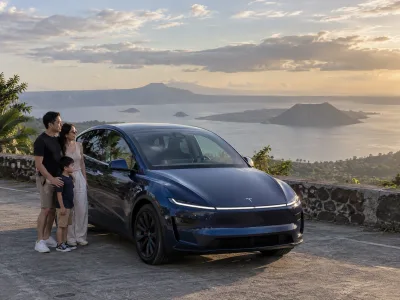
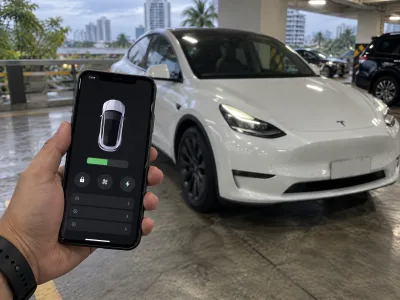
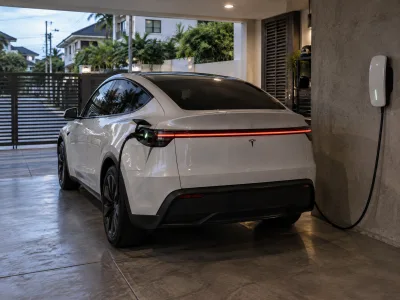
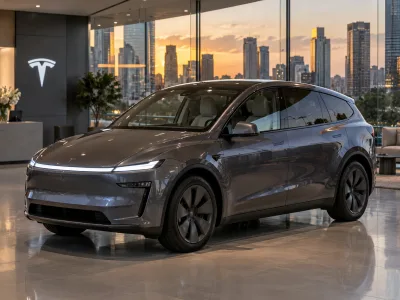
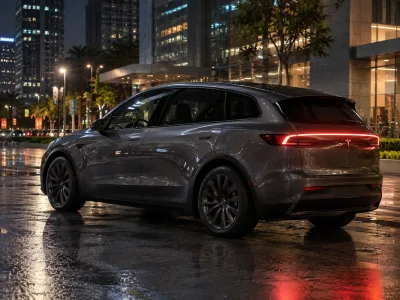
Related articles
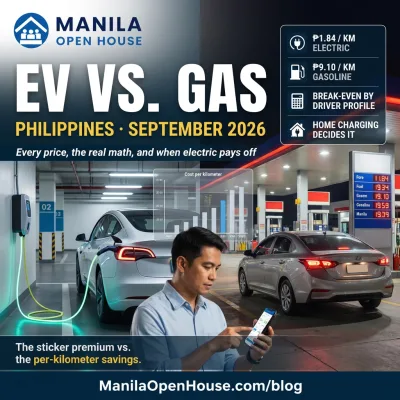 ▶ Video
 EV vs Gas in the Philippines, September 2026: Every Price, the Real Math, and When Going Electric Actually Pays Off
Dated snapshot — Sept 22–28, 2026 The one-line thesis: a home-charged EV runs at roughly ₱1.84/km versus ₱9.10/km for a Vios-class gas car at this month's pump…

One Person Corporation to Exit: What Investors Want in the Philippines
You can own every share of your company and still build something another investor will want to buy. The harder question is whether the company can keep…
 ▶ Video
 4 Green Certifications, 1 Tower: How Sondris by Arthaland Earns LEED, WELL, EDGE & BERDE
Most Philippine condominiums pursue one green-building certification, if any. Sondris, the Arthaland x Mitsui Fudosan tower rising in Legazpi Village, Makati,…